Background
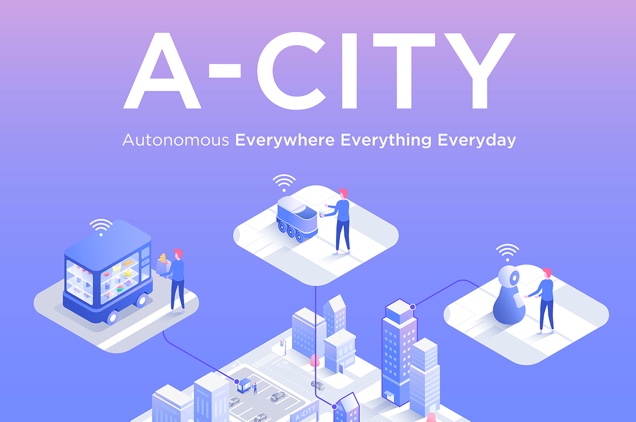
We live in an era where technology catches up with our imagination. Scenes from sci-fi movies will become reality in the near future. NAVER LABS is currently focused on the concept of “autonomous space,” which will reshape future cities. Every city space will be connected to a wide array of autonomous machines, and cities will analyze vast amount of data to make predictions, whereby many services such as delivery and logistics will be fully automated. Daily spaces will be connected in a completely different way than they are today.
Among such spaces, the circumstances of roads are somewhat unique and differ from those of indoor spaces. This is because there are set traffic rules and various signals, as well as the ever-changing traffic environment. LAVER LABS has been engaged in various research on autonomous driving since 2016. Here is an unveiling of one of the many projects NAVER LABS has been working on. It is called the ALT project, which focuses on the development of an autonomous-driving robot platform.
What’s ALT?
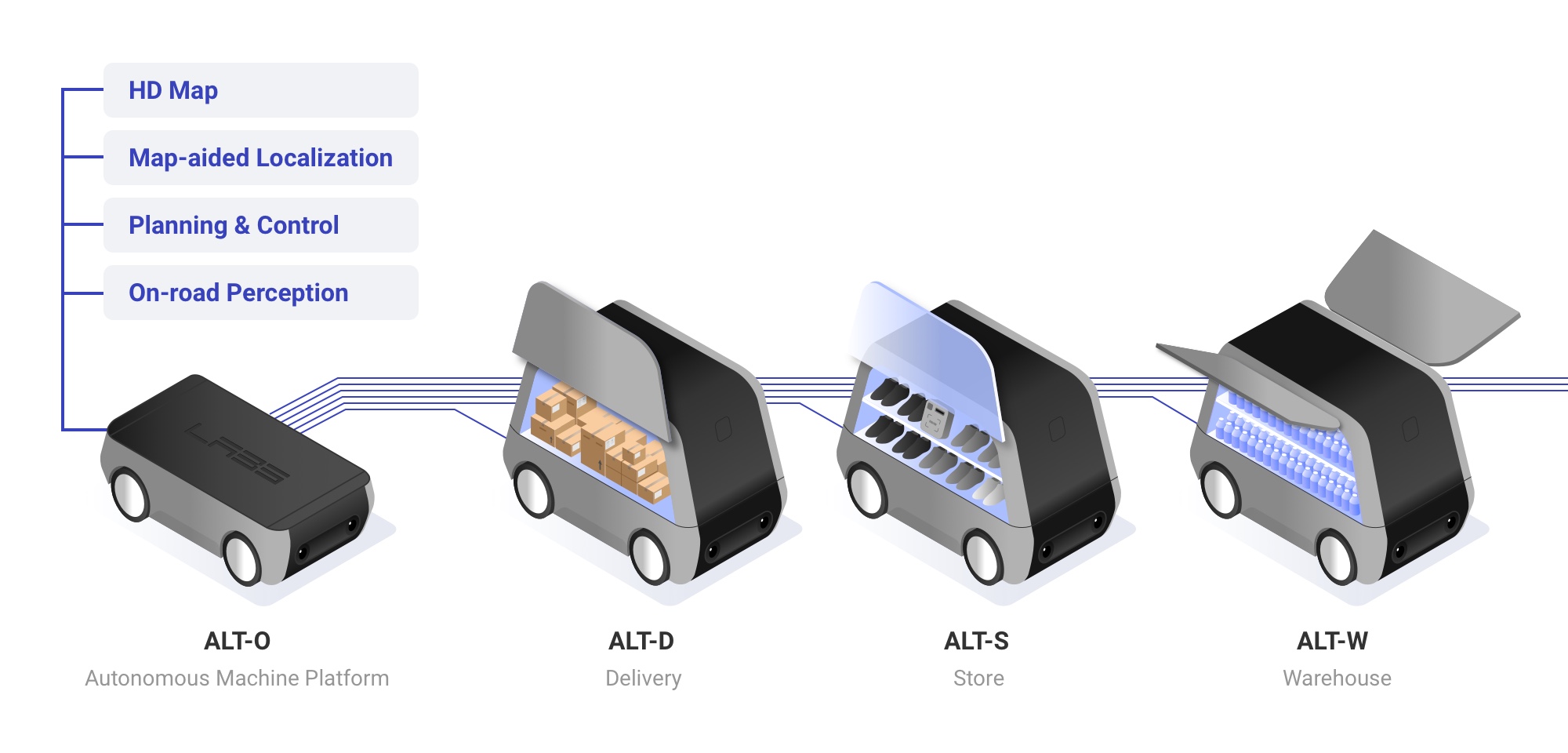
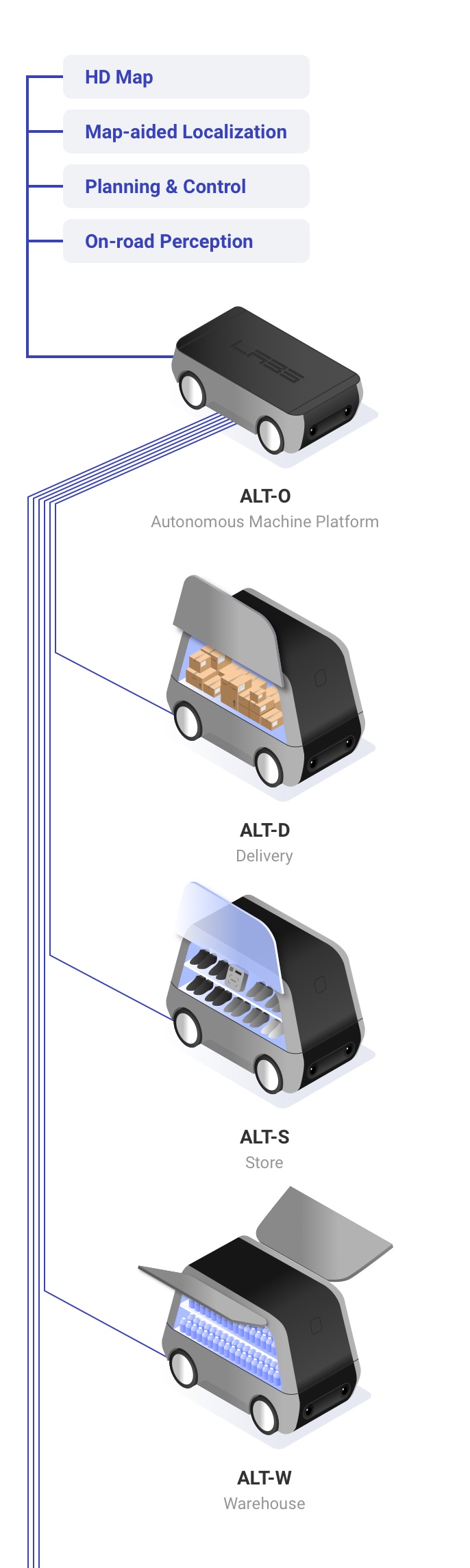
The ALT project aims to develop an autonomous-driving robot platform that can be customized in various ways to serve a special purpose. NAVER LABS is packaging the core technologies and data for autonomous driving based on the hardware of ALT-0 (read: “zero”) for pilot testing to be carried out in 2020.
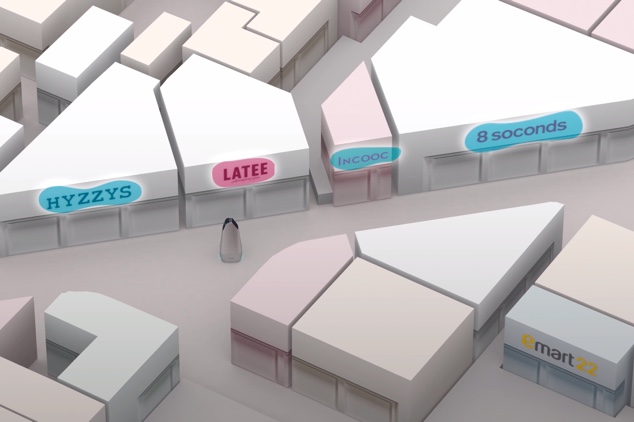
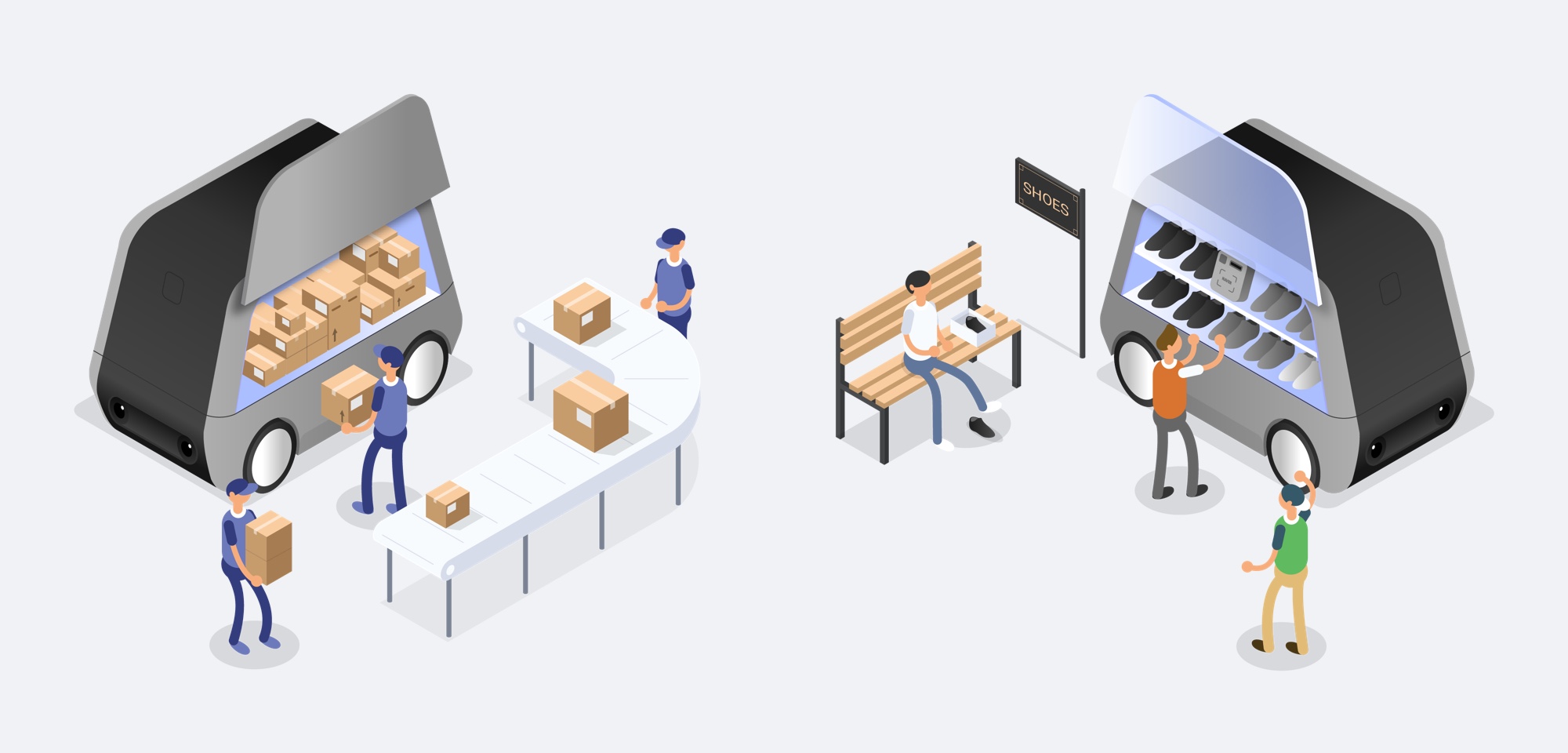
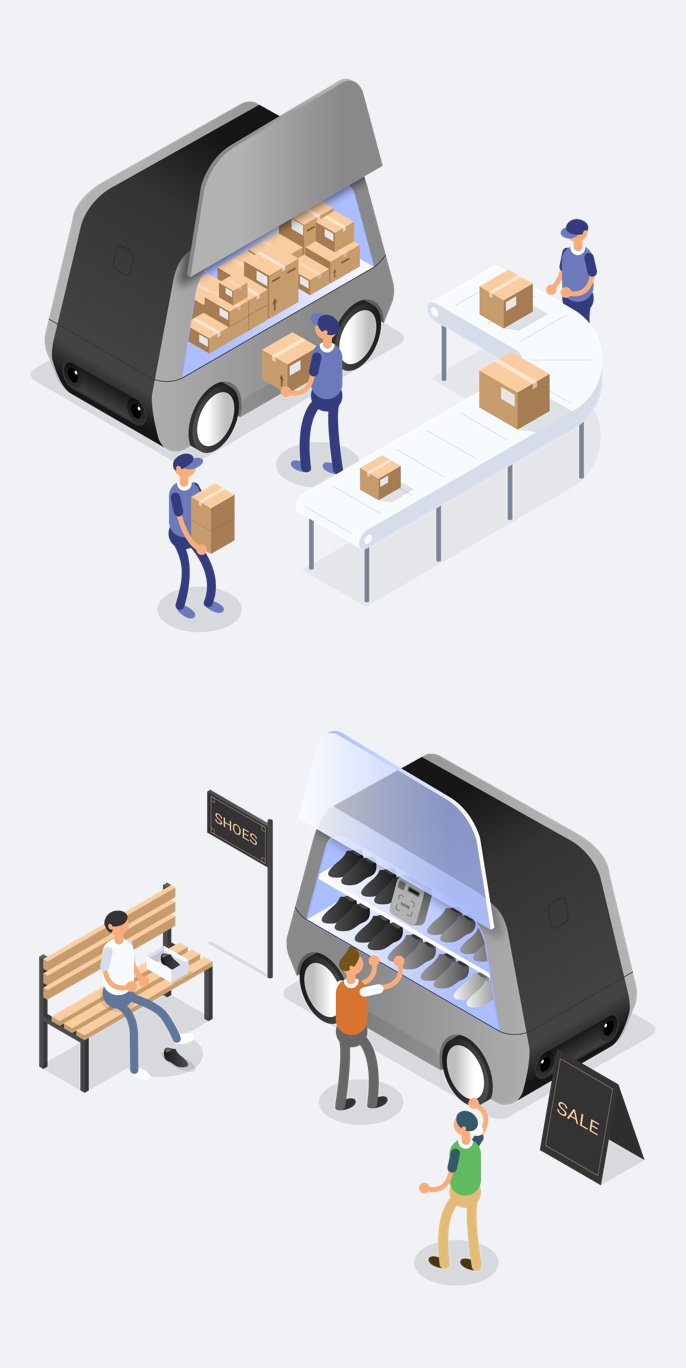
ALT-0 will be transformed into many different forms to offer various services in the future. Imagine the following scenarios: you can have products that you ordered earlier today loaded on to ALT-D and delivered to your home within just a few hours; you can get to actually see products on your wish list via ALT-S before making a purchase. From daily delivery of fresh produce and food to even moving libraries and popup stores, a new era of experience will unfold for consumers as well as service providers.
Tech in ALT
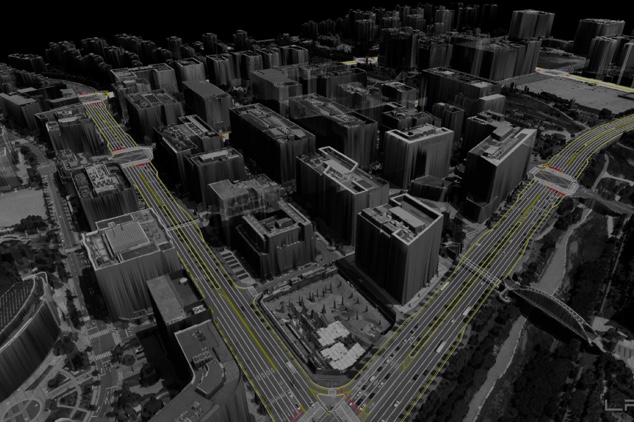
NAVER LABS will integrate all of its autonomous driving technologies with ALT, and it will comprise the most advanced algorithms and high-precision data. Since being the first in the IT industry to be granted a permit for provisional autonomous driving operations by the Ministry of Land, Infrastructure and Transport (MOLIT) in 2017, NAVER LABS has traversed many miles around complex city spaces to make technological advancements and improvements. These technologies accurately recognize lanes, traffic lights, and traffic signs through machine learning and computer vision algorithms, and come up with optimized routes to destinations in real time to plan effective driving. Such technologies include a large detailed map produced by hybrid HD mapping, and algorithms that converge this map data with various sensor data to ensure continuous and reliable location recognition even within skyscraper-dense areas.
Driving Technology
- Mapping
- Localization
- Perception
- Planning & Control
Plan
NAVER LABS plans to first upgrade the safe and efficient autonomous-driving robot platform through pilot testing of ALT-0, and will demonstrate the customized version combined with various service scenarios. The ultimate goal is to integrate ALT-0 with the indoor autonomous-driving robot platform and establish connection to every space. (To this end, NAVER LABS has also developed the AROUND platform, a cloud-based robot that drives around in indoor spaces autonomously.)
Previously, we had to physically go somewhere to buy stuff. Essentially, logistics and delivery services are just covering someone else’s travel time. Would that be the same in the future? Couldn't the space itself containing the goods and services come to us? This may sound like a completely new concept, but this imagination is already technically feasible. Then, when applied to each service area, it will create a whole new experience.
NAVER LABS is developing the technologies to bring such imagination of the future onto the real road.