In 2022, NAVER began operating its first ARC-powered robot services at 1784, NAVER’s second headquarters. Now, four years later, ARC has moved beyond a single building and is expanding into robotics-integrated building projects spanning the GAK Sejong data center, Japan, and Saudi Arabia.
It all began with a simple question. What does it take for dozens of robots to work reliably in the same space as people? NAVER LABS has explored this question at 1784, a real-world operating environment for robot services. Over the past four years, this exploration has shown how robots, infrastructure, and services can come together within one integrated architecture, providing the basis for ARC to scale.
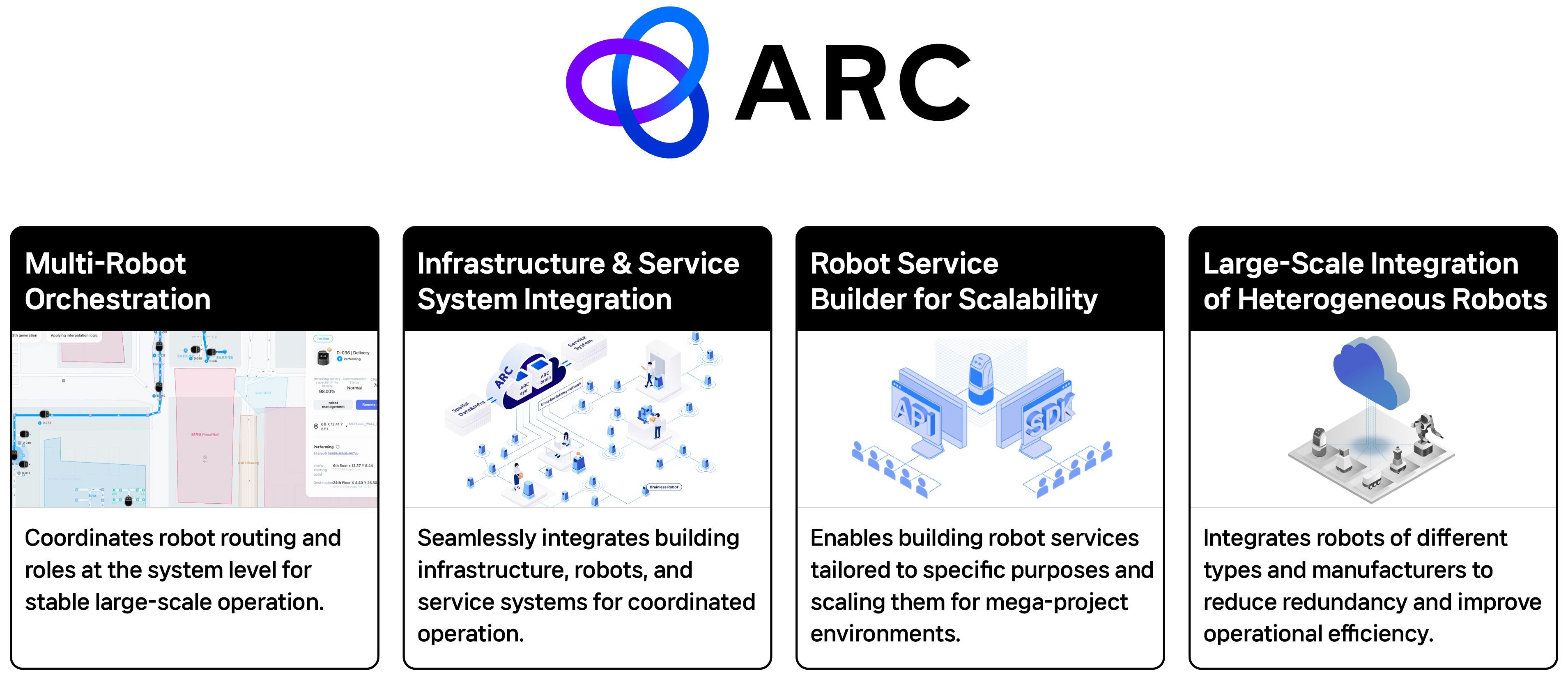
That question is now being taken to a larger scale. Can the same architecture continue to support operations across different spaces, robot types, and service requirements?
What began as an experiment at 1784 is now expanding into real-world operations at global sites. In Japan, NAVER conducted a robot service pilot with NTT East at Tokyo Midtown Yaesu. In Saudi Arabia, NAVER continues to deploy robotics and digital twin technologies on-site through projects such as NHC’s smart-city initiatives and the New Murabba office project.
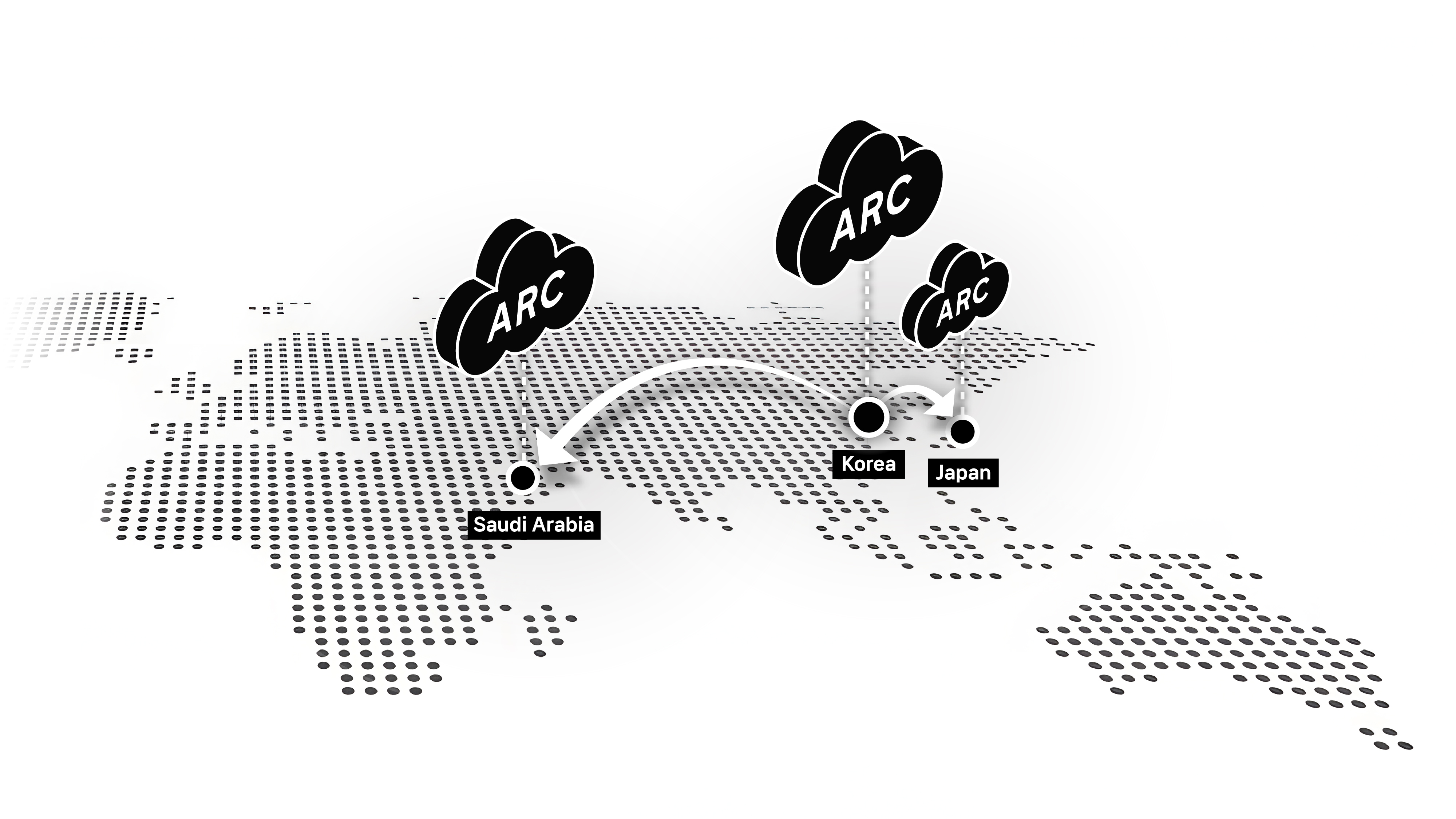
ARC grew more sophisticated with each new deployment. Overseas projects helped ARC move beyond a single building and evolve into a robot operations platform that can work across diverse environments. Different sites bring different requirements. Robots need to know where they are even as their surroundings change. They need to move in coordination even when they come from different manufacturers. The services built around them should be quick to develop and adaptable to each local context.
Where do bottlenecks arise when dozens of robots move at once? How should elevator calls be distributed? Which routes are safer during peak hours? These are the kinds of questions that only surface in real-world service environments. The past four years have been about finding answers to those questions.
Data as a Core Asset
Over the past four years, ARC has built more than a system. It has also built a growing body of data.
As robots move through real-world spaces, they generate vast amounts of data. The spaces they see, the situations they encounter along the way, the requests they receive and complete, congestion patterns by time of day, and recurring exceptions all become part of the operational data.
These different types of data do not remain separate from one another. Research is underway to connect robot sensor data, spatial data, and service data into a single pipeline that continuously improves robot capabilities. This creates a loop in which exceptions and recurring patterns from real-world environments feed back into learning, and what is learned is then applied to robot operations.
.png)
Beyond Individual Robot Intelligence:
The Challenge of Systems and Scale
For robots to work in real-world spaces, model performance alone is not enough. No matter how intelligent the model may be, it is difficult to translate its intelligence into real-world operations unless it can function reliably across multiple robots, spatial infrastructure, and service systems.
This perspective was underscored at the “AI for Robotics” workshop held at NAVER LABS Europe. Professor Andrew Davison of Imperial College London, who first proposed the concept of spatial intelligence, noted that as robots are deployed in physical spaces, what becomes more significant than simply improving model performance is designing architectures that allow distributed systems to interoperate reliably. Justin Carpentier, a researcher in robot optimization and control, also emphasized an approach that improves system-wide efficiency through mathematical optimization.
In the end, what makes Physical AI at work competitive is not the intelligence of any single robot. The key to success in real-world operation lies in how reliably that intelligence can be deployed across many different types of robots, coordinated at scale, and connected to services.
Turning AI Agent Decisions Into Real-World Action
Four years ago, NAVER LABS put forward a bold goal: “We’ll sell ARC.” What began at 1784 is now extending to the GAK Sejong data center and robotics-enabled building projects overseas. ARC is moving beyond a single building and expanding its role as an execution platform for buildings and urban environments around the world.
ARC recognizes spaces, coordinates multiple robots, and executes services. It then feeds the data accumulated in the process back into robot intelligence. This robust structure creates new synergies when connected with NAVER’s digital services, such as NAVER Shopping, Map, and Pay. NAVER’s online service ecosystem helps AI agents make decisions, while ARC provides the foundation for translating those decisions into real-world execution.
With ARC connecting physical infrastructure and the online service ecosystem, NAVER services are expanding beyond the screen into real-world spaces where physical actions can actually be carried out. The declaration “We’ll sell ARC” is now evolving into a concrete plan to build execution infrastructure that bridges the online and offline worlds in the age of AI agents.