The next stage for AI is not inside a screen; it’s the physical spaces we live in. Having recognized this shift early on, NAVER LABS has been deeply researching spatial intelligence technologies.
One of NAVER LABS’ greatest advantages lies in its large-scale testbeds: NAVER’s second headquarters, 1784, and its data center, Gak Sejong. Here, NAVER LABS directly develops mapping devices and robots, continuously accumulating vast amounts of real-world data while testing and validating technologies every day.
So, how is AI evolving in relation to physical space? Let’s explore some key examples actively being researched at NAVER LABS.
1. AI That Models Space
To connect AI with the real world, space must first be digitally replicated. NAVER LABS has built its capabilities over time by developing its own mapping devices and algorithms, and is now expanding into new technological frontiers with entirely novel approaches.
■ DUSt3R
DUSt3R is one of the most groundbreaking AIs in spatial intelligence. It can instantly reconstruct a complete 3D space using only 2D images without complex equipment (even a single image is enough), allowing it to fundamentally reshape global research paradigms. This means robots can understand spatial environments using only camera inputs. DUSt3R has already sparked a wave of follow-up research from major global tech companies, and a commercial version is expected to be released soon.
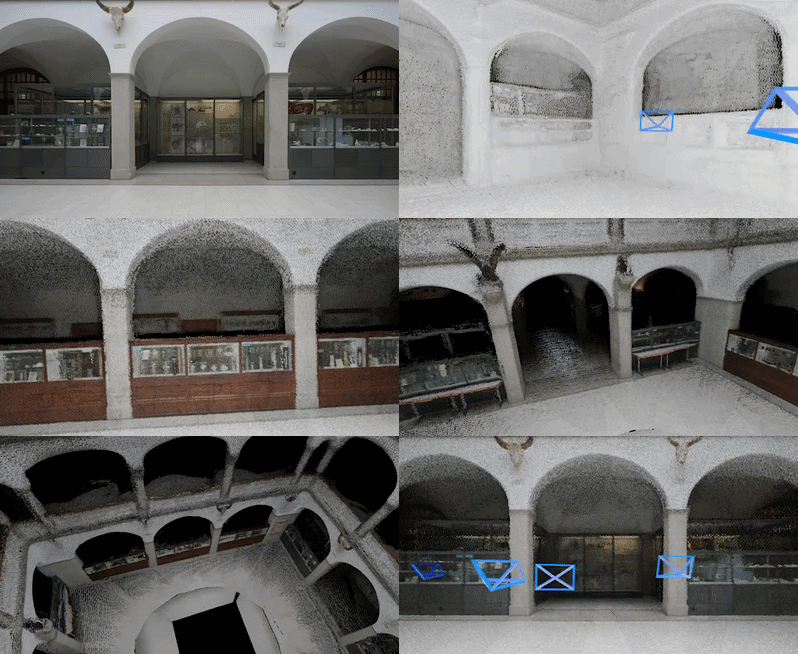
3D space reconstructed from multiple images using DUSt3R
■ Novel View Synthesis (NVS)
NVS analyzes multiple images or videos to generate a 3D scene from entirely new viewpoints that were never originally captured. It goes beyond the limitations of physical photography, allowing creators to freely build whatever perspective or composition they desire. NAVER LABS has rapidly internalized this technology and applied it to projects such as the Disney+ drama Tempest and NAVER Map’s Flying View 3D. In particular, for NAVER Map, NAVER LABS built a large-scale city-level NVS pipeline using data collected through its proprietary mapping system, P1.
_(1).gif)
Free-flying viewpoint visualization between buildings enabled by NVS
2. AI That Understands Space
Once a precise 3D replica of space is created, the next step is for AI to “open its eyes.” This goes beyond simple object recognition: AI must understand dynamically changing environments in three dimensions.
■ Visual Localization (VL)
The first step in spatial understanding is knowing exactly “where I am.” VL determines precise 3D position and orientation from just a single image, even in indoor or GPS-denied environments. It maintains stable performance despite lighting changes, interior modifications, and crowded environments with heavy foot traffic. This is a core technology that allows the many autonomous robots in 1784 to navigate seamlessly without getting lost.
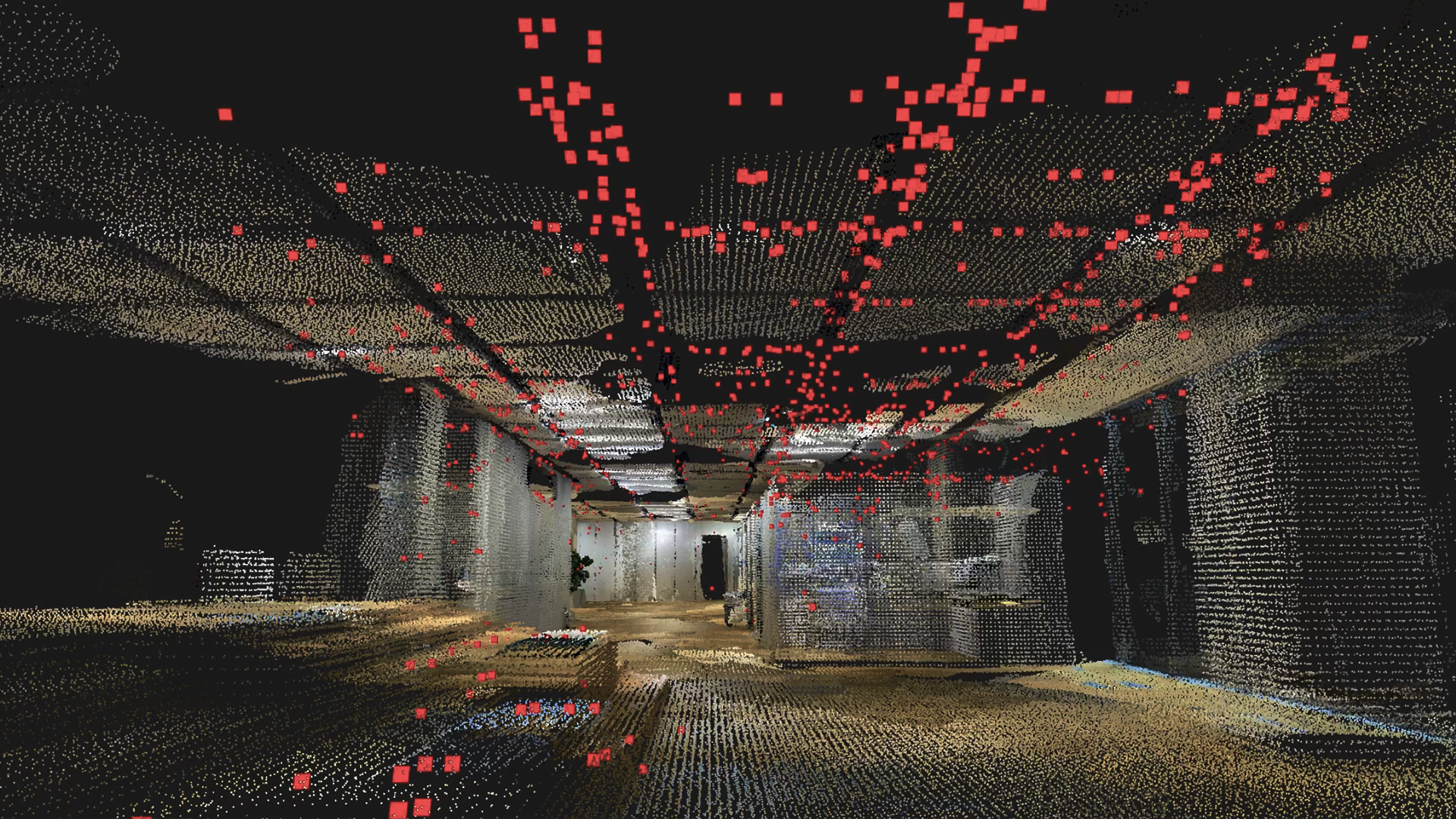
VL technology identifying location from a single image
■ HUMANS
HUMANS reconstructs a person’s 3D pose, body shape, and even subtle movements from 2D images or videos. Humans are the most dynamic and critical element in any space; they are both obstacles robots must avoid and entities they must closely interact with. HUMANS doesn’t just identify where a person is, but also interprets how they move within context. This research extends into areas such as Digital Humans within digital twins and mixed reality (XR), expanding how AI interacts with people.
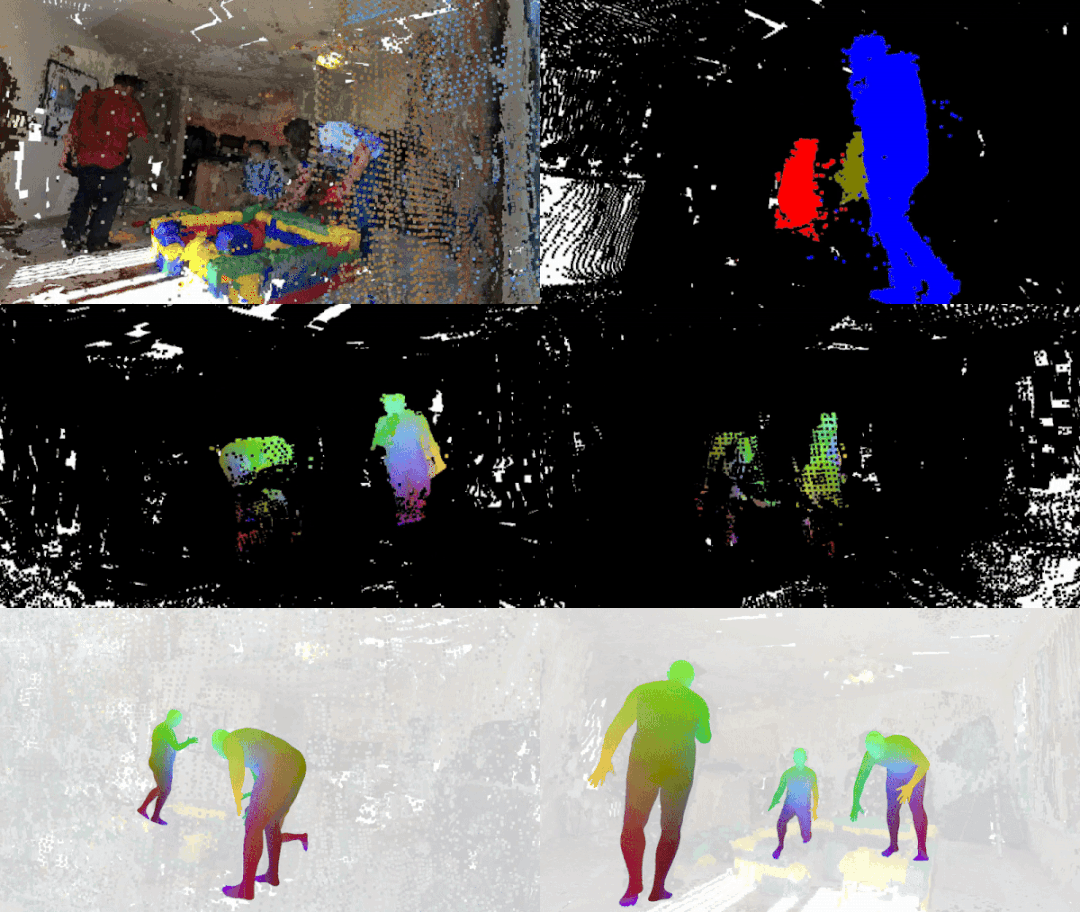
3D reconstruction of scenes including humans
3. AI That Acts in Space
Once AI can model and understand space, the next step is clear: translating that understanding into real-world action. The key medium here is robotics. Robots give AI a physical body, enabling it to act directly within real environments.
■ Simulation for Robot Learning
For robots to operate reliably in the real world, extensive training is essential. To achieve this, highly detailed simulation environments are created based on real-world spaces. Within these virtual environments, robots can safely undergo repeated training before being deployed in reality. NAVER LABS’ ability to tightly connect simulation and real-world environments is a major strength, made possible by its vast repository of spatial data.
Autonomous robot simulation conducted in a 3D reconstruction of 1784
■ Autonomous Robot Navigation
Robot mobility is also rapidly advancing. Foundation-model-based AI trained on massive spatial datasets can instantly interpret visual data from cameras, understanding not only individual objects but also spatial structures and surrounding movements. Even in complex environments filled with pedestrians and moving objects, robots can assess risks and determine optimal paths on their own. Operations have actually become simpler: unlike the past, where countless rules had to be predefined, robots can now move autonomously without explicit instructions. They go beyond following fixed routes, understanding situations in real time and navigating “like humans.”
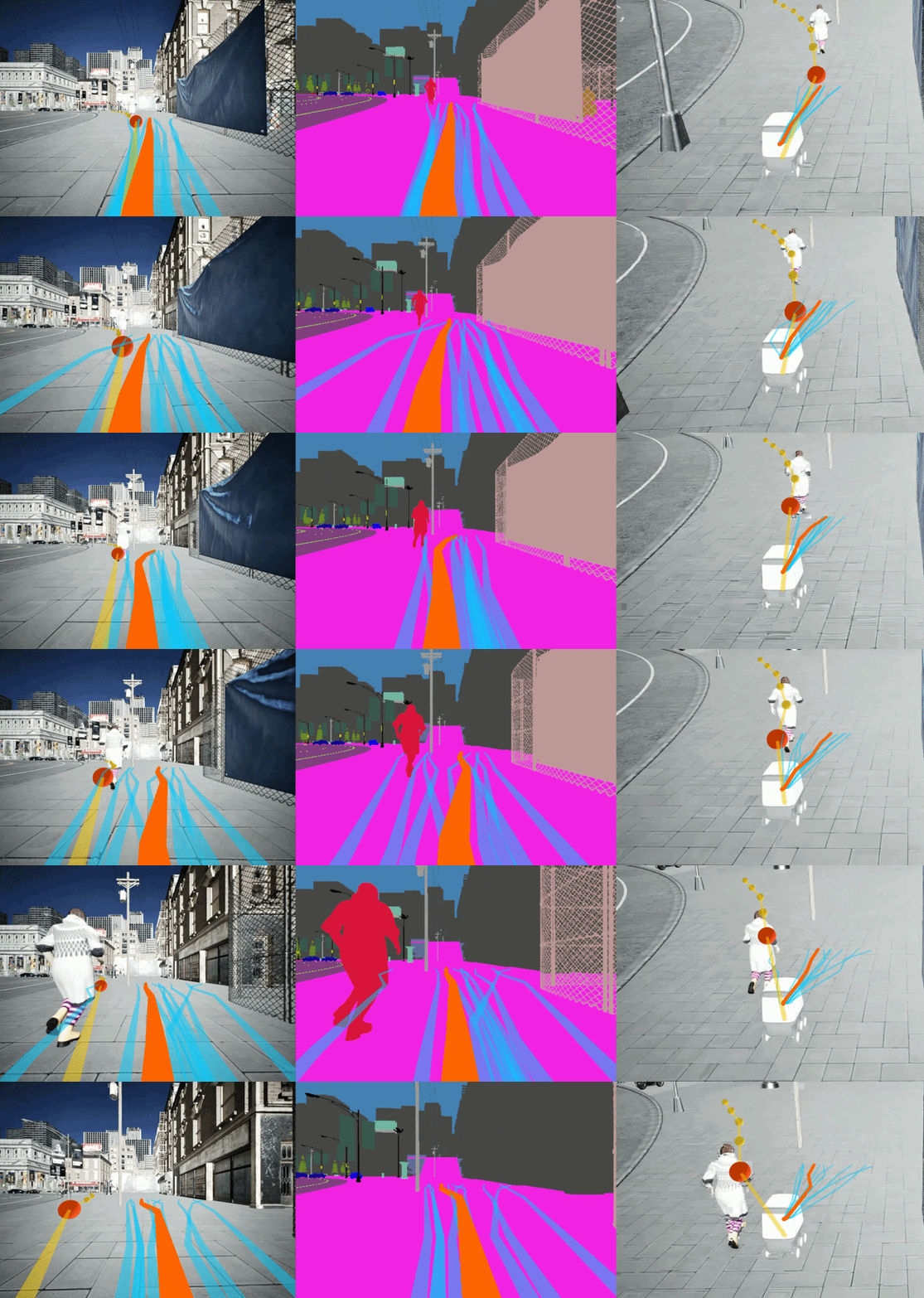
NAVER robots practicing advanced autonomous navigation in 3D space
Furthermore, technologies that precisely understand the 3D structure of spaces and objects can extend into robotic manipulation. Tasks such as grasping and moving objects depend on understanding the “micro-space” between the robot and the object.
In reality, these three categories are simply a framework for understanding. The technologies themselves are deeply interconnected, and they share a common goal: enabling AI to deeply understand the complexity of the physical world and evolve into a practical partner that can solve real-world problems.