In our daily lives, there are still many unsolved problems related to space and movement between spaces. These are the problems that NAVER LABS is concerned about. Through the keynote speech given at DEVIEW 2018, we revealed our past deliberations on these issues and the results of our research.
"AI: Not Artificial Intelligence, Ambient Intelligence"
This was the talking point of the keynote speech. Ambient intelligence refers to “a technology that provides relevant information or actions in a timely and natural manner by recognizing and understanding the environment and its context,” and this is our technological vision. With this in mind, we unveiled the xDM Platform, an integrated location and mobility solution for people and self-driving machines. “xDM” stands for “extended definition and dimension map.” It is a combination of mapping, localization, and navigation technologies together with all the precision data we have gathered so far.
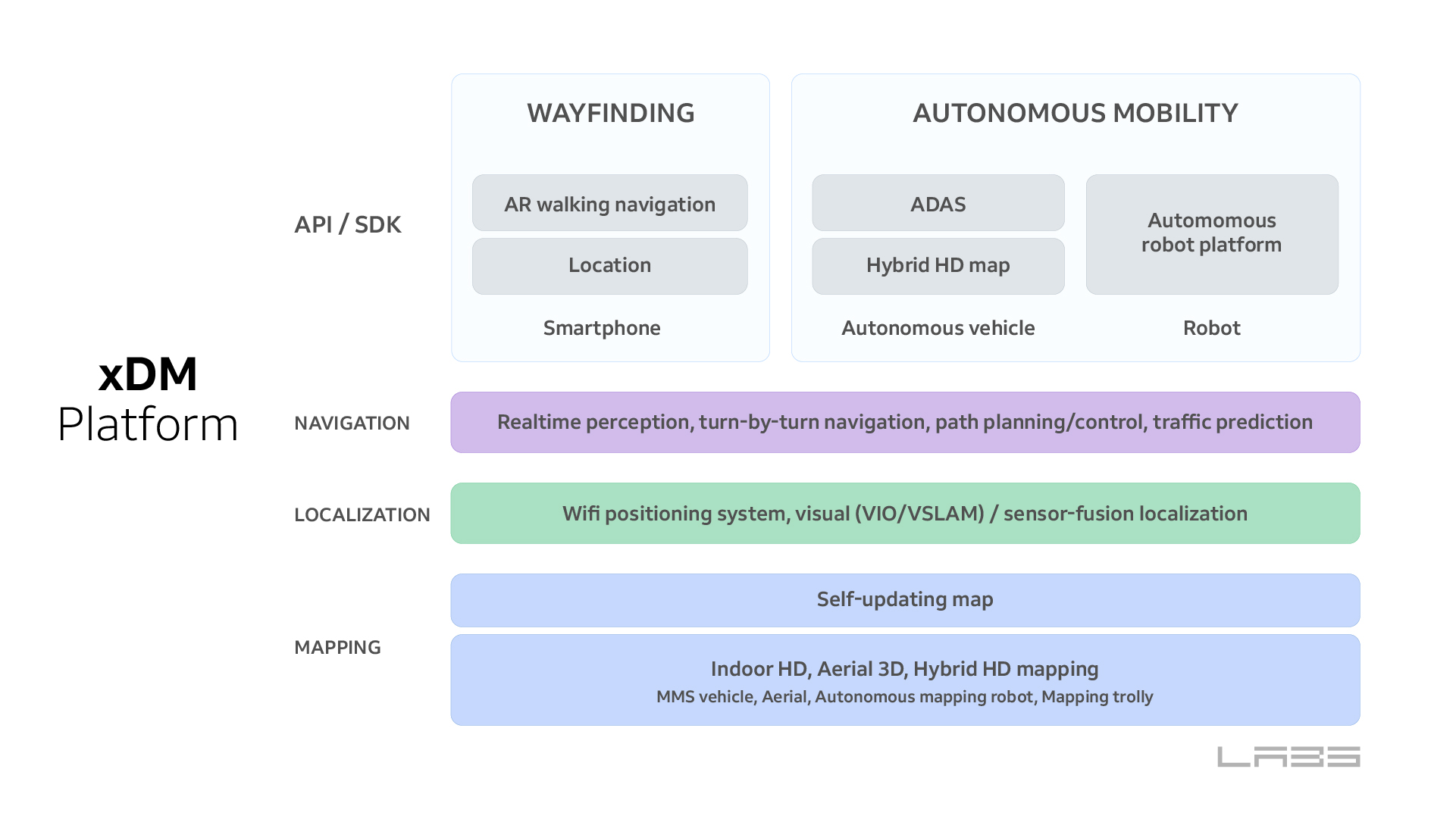
It constructs precise 3D maps for indoor and outdoor environments to be used on smartphones and in self-driving machines and it has rendering technology to automatically update those maps. It offers precise measuring technology that covers indoor, outdoor, and road environments without leaving any blind spots. It also stores real-time and real-space data, generating movement information and understanding contexts.
The xDM Platform, which is a combination of the aforementioned technologies, is comprised of two packages. One package is the Wayfinding Platform and it is designed to help people search for their current location and to get directions through indoor and outdoor environments. The other package is the Autonomous Mobility Platform designed for vehicles and self-driving machines.
The Wayfinding Platform for People
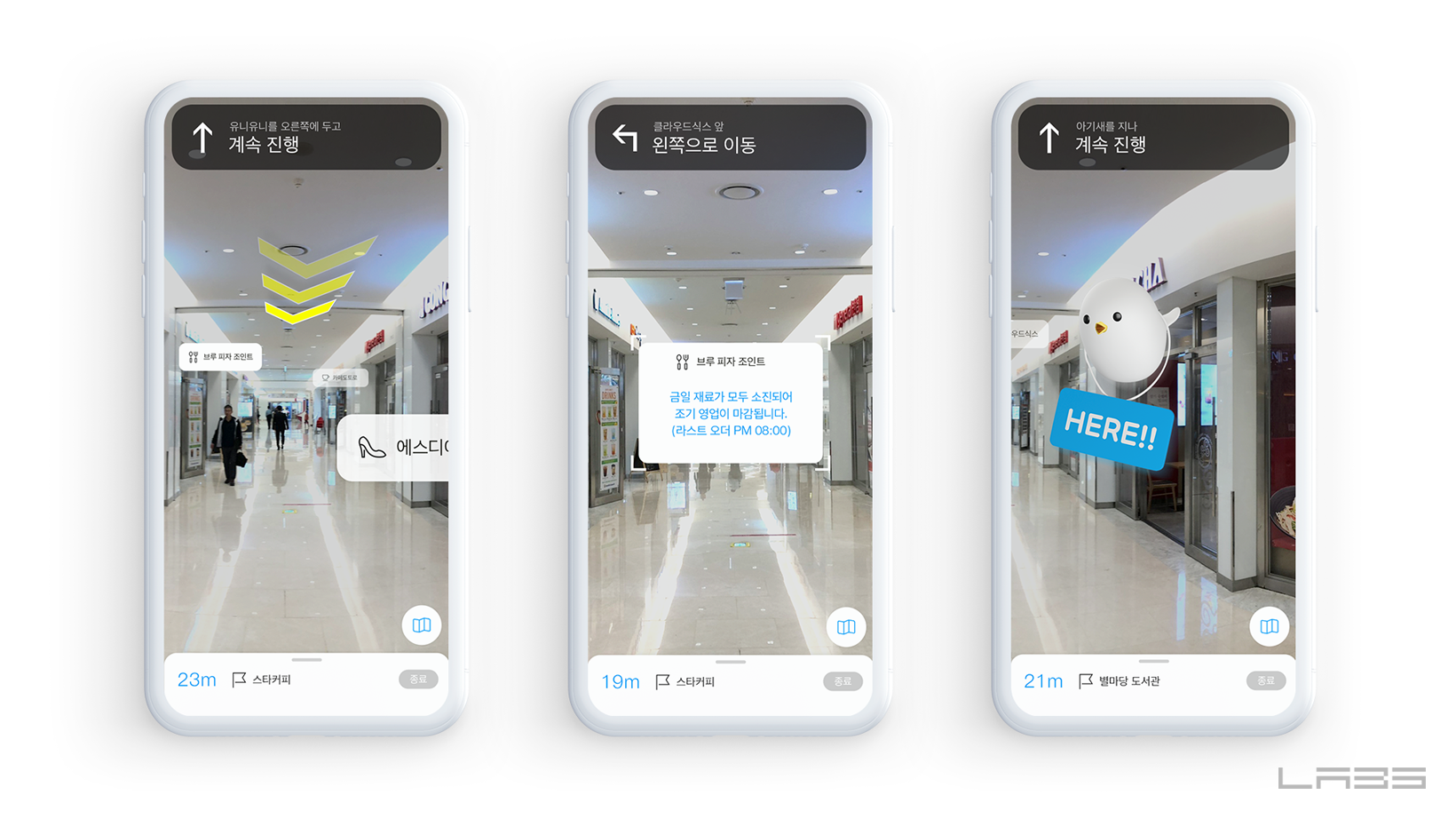
The Wayfinding Platform is a solution that allows people to move in a faster and on more convenient paths. Through a location API, this platform provides detailed location/movement information, such as smart geo-fencing, mobility pattern analysis, personalized localization, and so on, to the user. In addition, the POI information continuously updates through the road/AR navigation API, and it navigates users along the quickest routes in a fast and easy way, even inside large-scale indoor spaces where GPS functions do not work. M1, the mapping robot, can recognize the user’s current location accurately on the 3D rendered indoor map by utilizing visual and sensor-fusion localization technology without the need for separate geolocation infrastructure. It also provides turn-by-turn (TBT) information based on geographic features, and delivers navigation information more intuitively through the AR navigation API.
In the keynote address, a demonstration of the AR navigation technology was performed in COEX, Seoul. Also, our plan to collaborate with premier partners, HERE and Incheon Airport Corp., was disclosed. We are waiting for more partners to collaborate with us.
We also introduced scalable and semantic indoor mapping (SSIM) that automatically maintains updated indoor maps. It is a technology that automates the indoor map creation process, data collection, and maintenance processes utilizing NAVER LABS’ technologies in robotics, computer vision, visual localization, machine learning, and so on.
Currently, we are focusing on the POI change detection stage where a self-driving service robot operating in indoor spaces automatically detects changes in POI, and these changes are updated on the map. In the future, this will be extended to POI recognition and semantic mapping. The same technology will be applied in self-driving technology in outdoor and on road environments.
An Autonomous Mobility Platform for Self-Driving Vehicles and Robots
These days, mobility solutions do not apply only to people. Soon, self-driving technology for self-driving robots, not to mention self-driving vehicles, will penetrate deeply into our daily lives. The Autonomous Mobility Platform is a solution for self-driving machines.
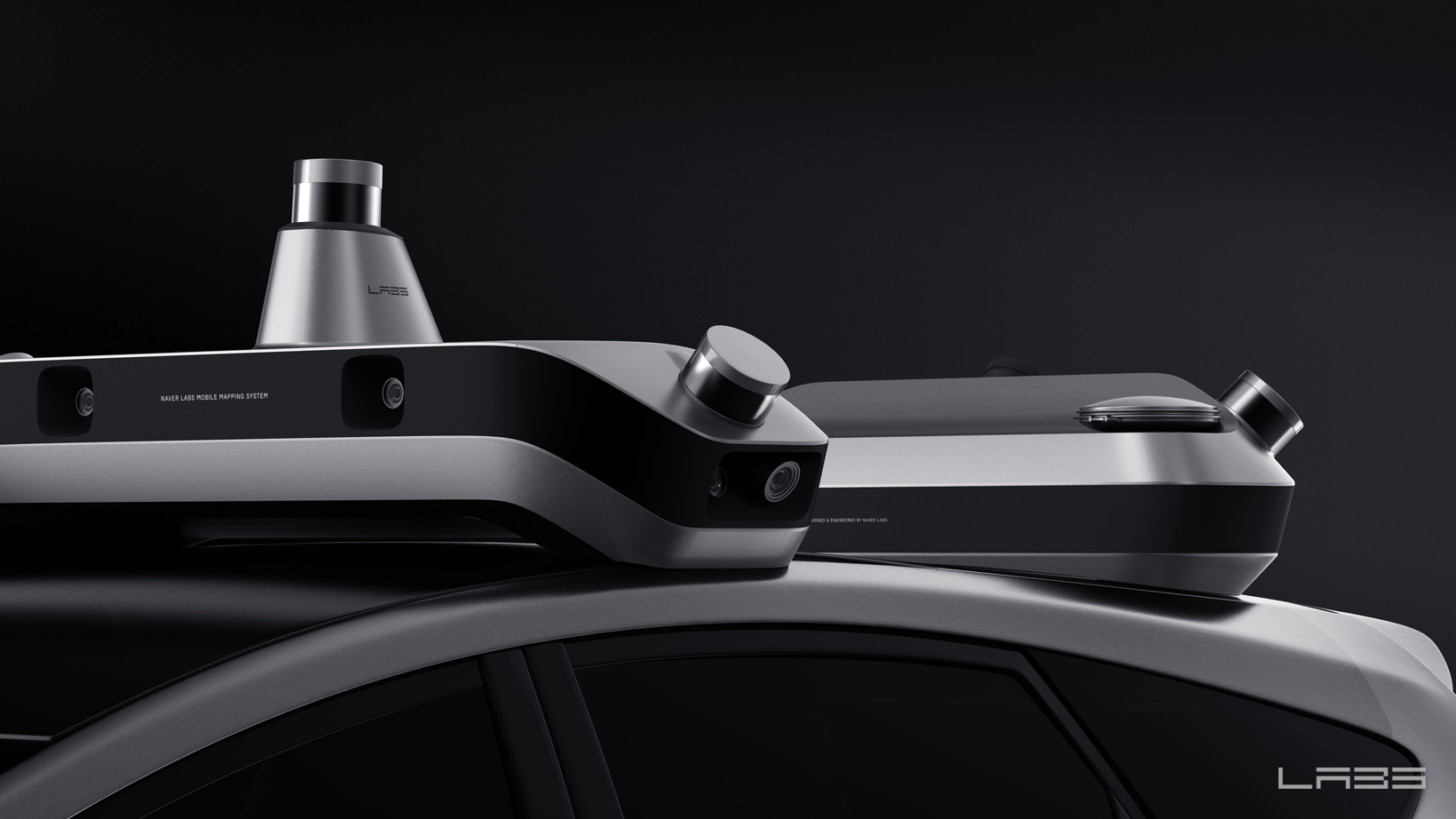
In this keynote address, we unveiled new HD mapping technology for self-driving vehicles. An HD map is essential data required for self-driving vehicles to identify their exact location and to search for the most optimal route to a destination. NAVER LABS utilizes Hybrid HD Map solutions to create HD maps for each city by organically integrating route networks extracted from precision aerial photographs and data collected by R1, NAVER LABS’s mobile mapping system. We are implementing algorithms for both 2D and 3D data that automatically extract the features required for mapping.
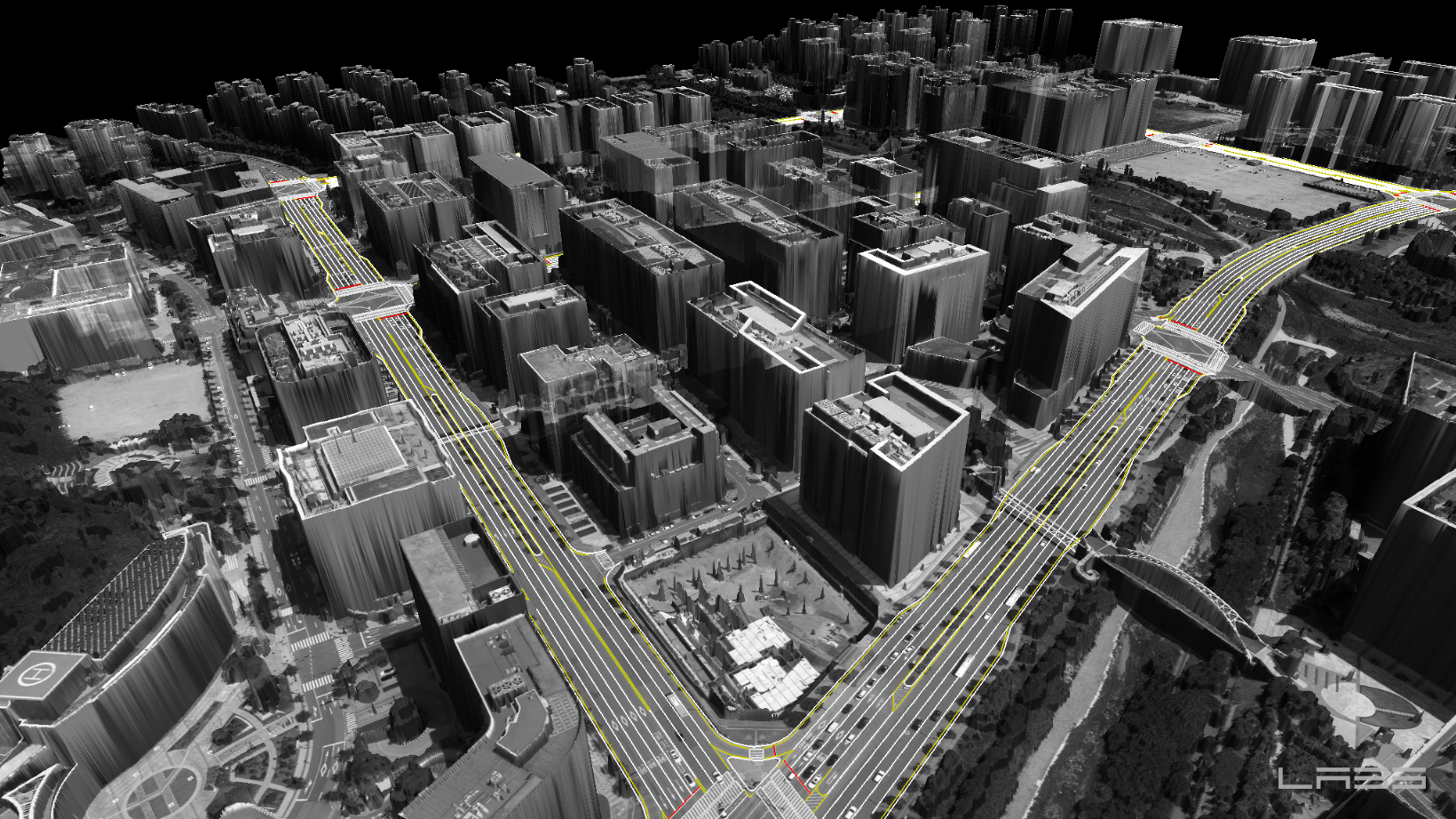
In addition, based on this HD map, we are developing a solution that can accurately measure locations, even in shadowy areas like city centers where GPS signals cannot reach because of the high rise buildings, by combining the map with information collected through a self-driving vehicle’s GPS sensor, IMU sensor, CAN data, LIDAR signals, and camera visuals. Furthermore, we are collaborating with Qualcomm and Mando on research for ADAS technologies in connection with Hybrid HD Maps, and various other self-driving technologies.
The AROUND platform is a solution for bringing self-driving service robots to the mainstream. It utilizes precision 3D maps, created with M1, and cloud-based route search algorithms to reduce the cost of robot production while also maintaining high quality self-driving performance. Unlike conventional self-driving robots which have to perform core functions, such as map creation, location identification, route creation, obstacle avoidance, and more, by themselves, this platform can bring about indoor self-driving with a high-degree of precision with only low-cost sensors and by using a small amount of processing power.
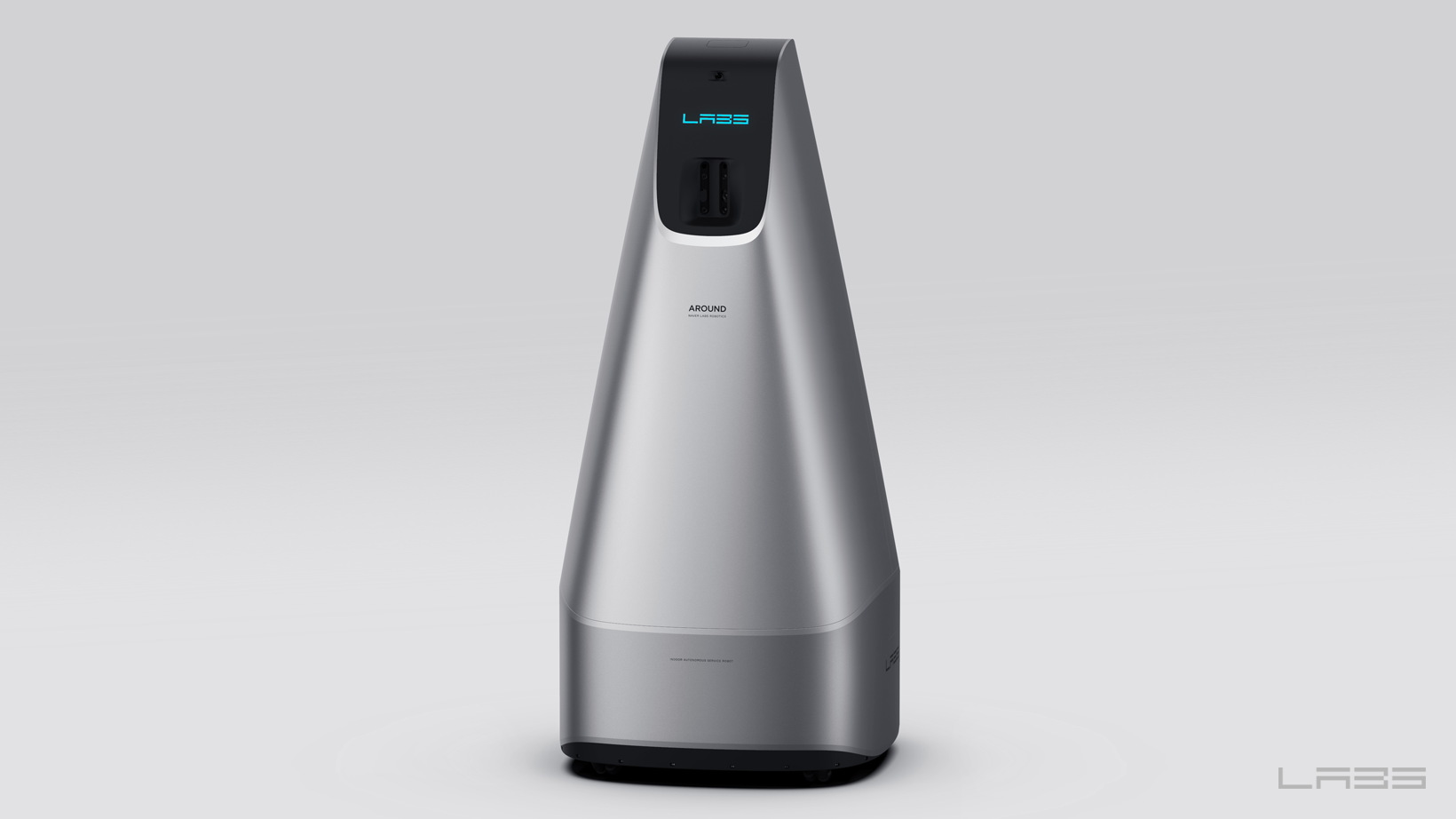
Continuing from AROUND, which was used in YES24 book stores last year, we are now developing AROUND G, a self-driving guide robot that provides direction services in large-scale indoor spaces, such as shopping malls or airports. AROUND G will be outfitted with the AR navigation API to offer directions and guide with an even more intuitive UX.
Ambient Intelligence Technologies for the Present, Not the Future
In this keynote, we presented NAVER LABS’ research outcomes on optical technologies. AHEAD is a 3D AR HUD (Heads-Up Display). It is uses 3D display technology to deliver information to drivers in a way that will not make them shift their focal point.
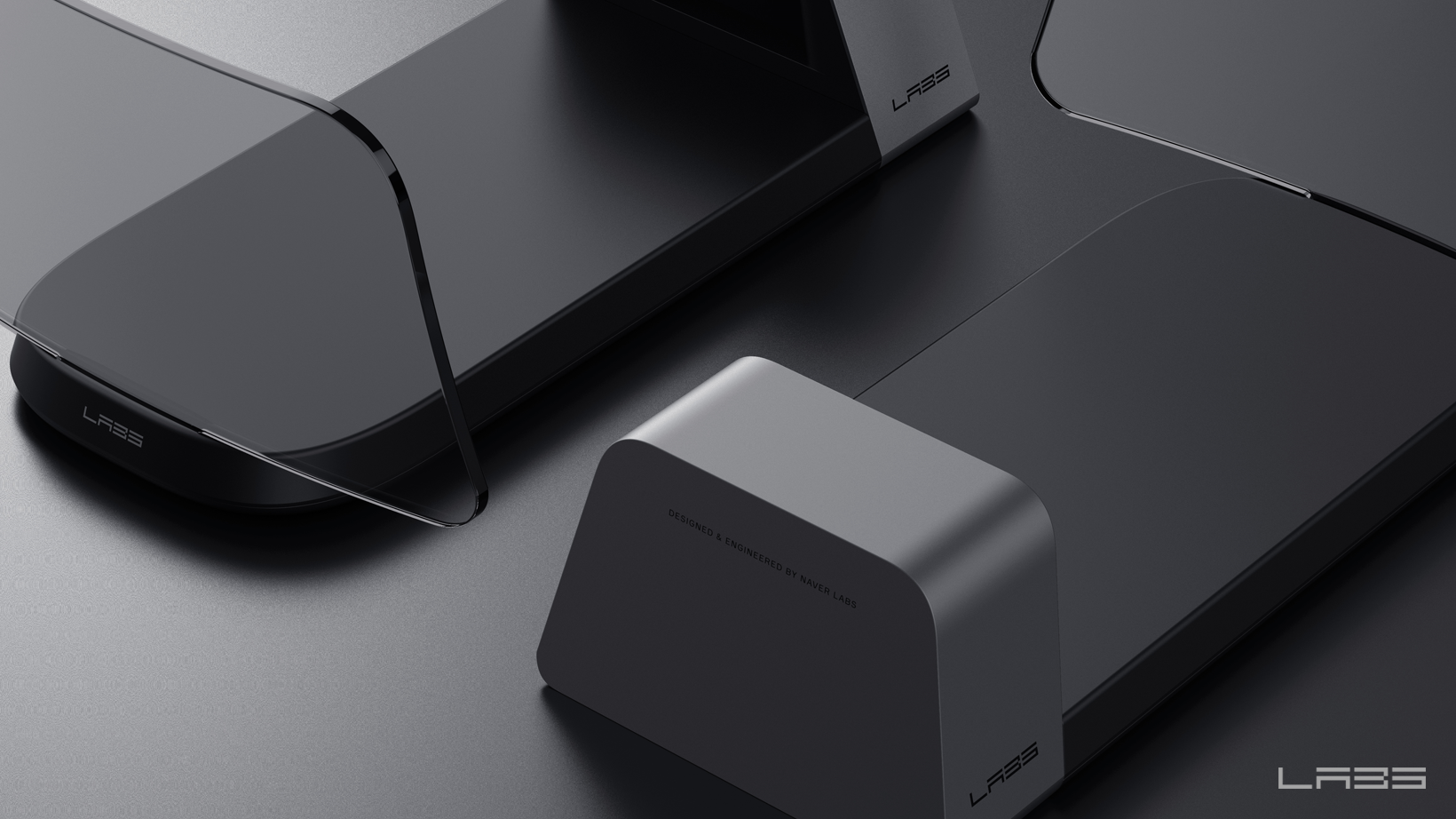
Since the actual view of the road that the driver is watching has the same focal point as the display, the driver can take in location and mobility information more easily and in a more natural way. In the future, various information and services provided by the xDM Platform may be delivered naturally to drivers through AHEAD.
We are also working on the sophistication of AMBIDEX, the robot arm we unveiled last year, to make it safer for interaction in daily environments. Unlike conventional robots which are primarily focused on location control, controlling strength is more important for AMBIDEX. For this reason, we have developed a simulator for kinetic and dynamic modeling. By running a simulator test before powering up the robot, we have been able to improve safety and quickly collect a vast range of data for different conditions.
NAVER LABS envisions a world where tools and technologies naturally coexist with our everyday life. Our presentation on the performance outcomes and the xDM Platform, through the DEVIEW 2018 keynote address, was part of our effort to realize that vision. We wish to understand the contexts of life in every space in which humanity resides, and to develop new services and tools based on that. We believe technology should understand people, people should not necessarily have to understand technology. NAVER LABS will not stop working towards the realization of this vision, and will continue to grow together with our partners, sharing our technology, and constantly introducing new platforms.