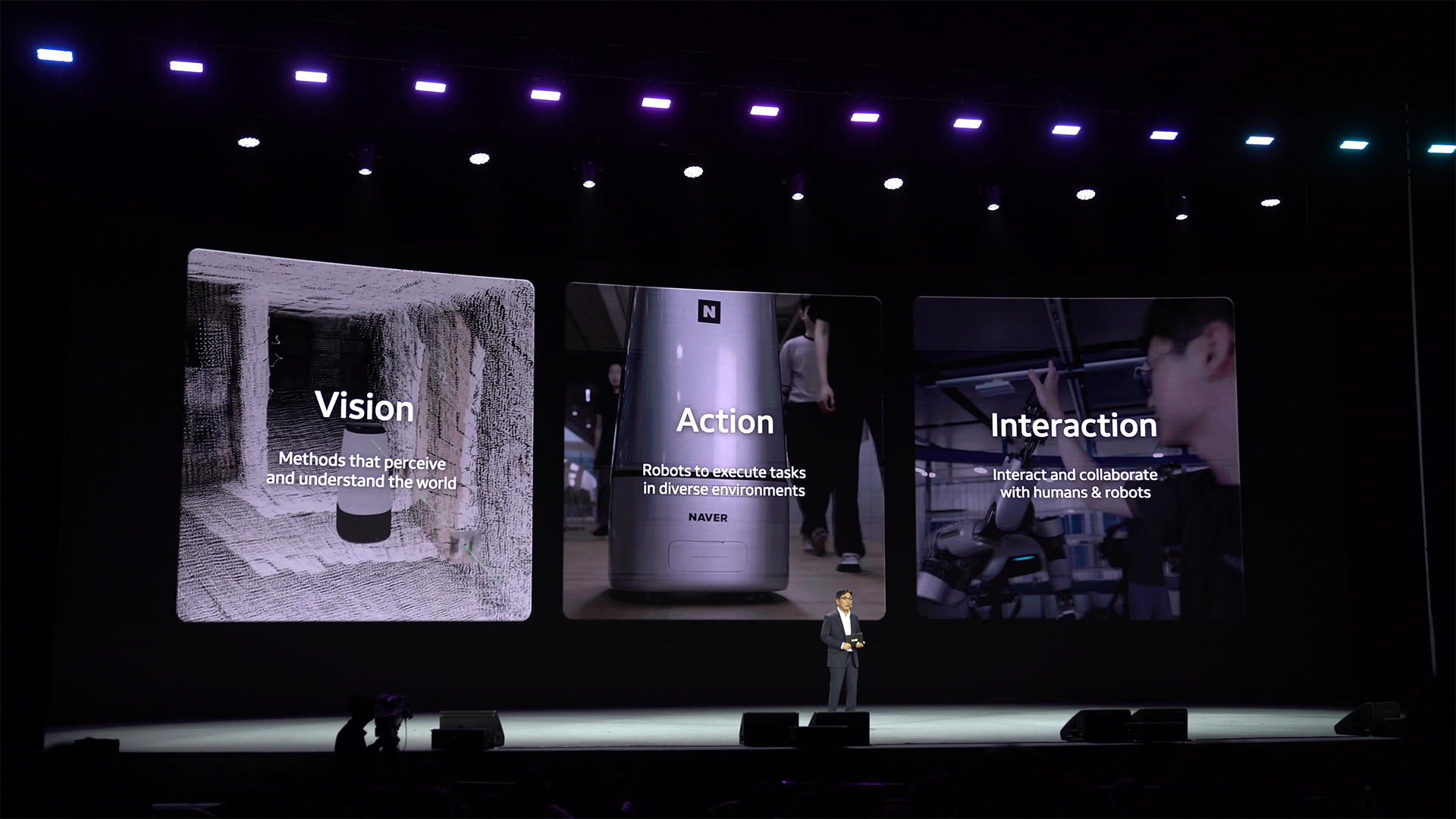
During the DAN25 keynote session, NAVER LABS’ Physical AI was introduced.
"Physical AI is not a new challenge for NAVER LABS. We began research in robotics and autonomous driving in 2016, and since 2021, we have been leading foundation model–based Physical AI research."
Kim Yoo-won, CEO of NAVER Cloud
“Physical AI” refers to the ability of machines to perceive and understand spaces, make decisions, and act autonomously within them. NAVER LABS has built up several distinctive strengths in this area, which can be summarized in three key competitive advantages.
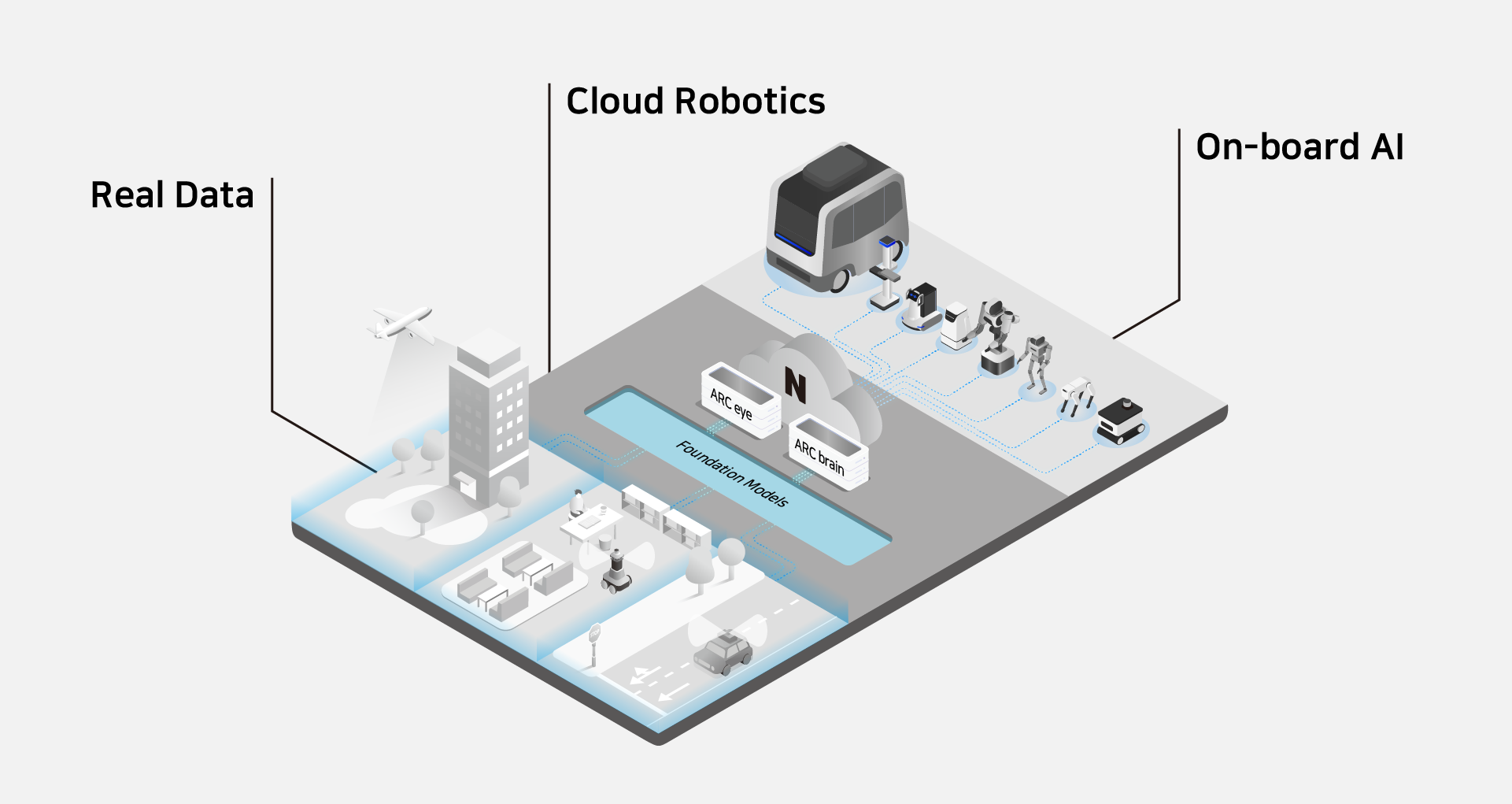
1. Real Data
NAVER LABS leverages real-world spatial and service data collected from its offices, data centers, and city-scale testbeds to train its AI systems. Rather than relying solely on synthetic data, the company uses high-quality datasets that reflect real-world variables and conditions, enabling AI to understand complex physical interactions and respond autonomously to them.
2. Cloud Robotics
Through ARC (Advanced Robotics Cloud), NAVER connects large-scale spatial information and diverse heterogeneous robots into a single intelligence on cloud infrastructure. The system’s real-time algorithm updates and continuous data circulation create an environment where robots can constantly evolve.
3. On-board AI
Lightweight yet high-performance foundation models are deployed directly on devices and robots. This allows them to process environmental variables swiftly and maintain high stability, even in conditions with unstable network connectivity.
Most importantly, all of these pipelines are seamlessly integrated, driving the evolution of Physical AI.
NAVER DAN 25
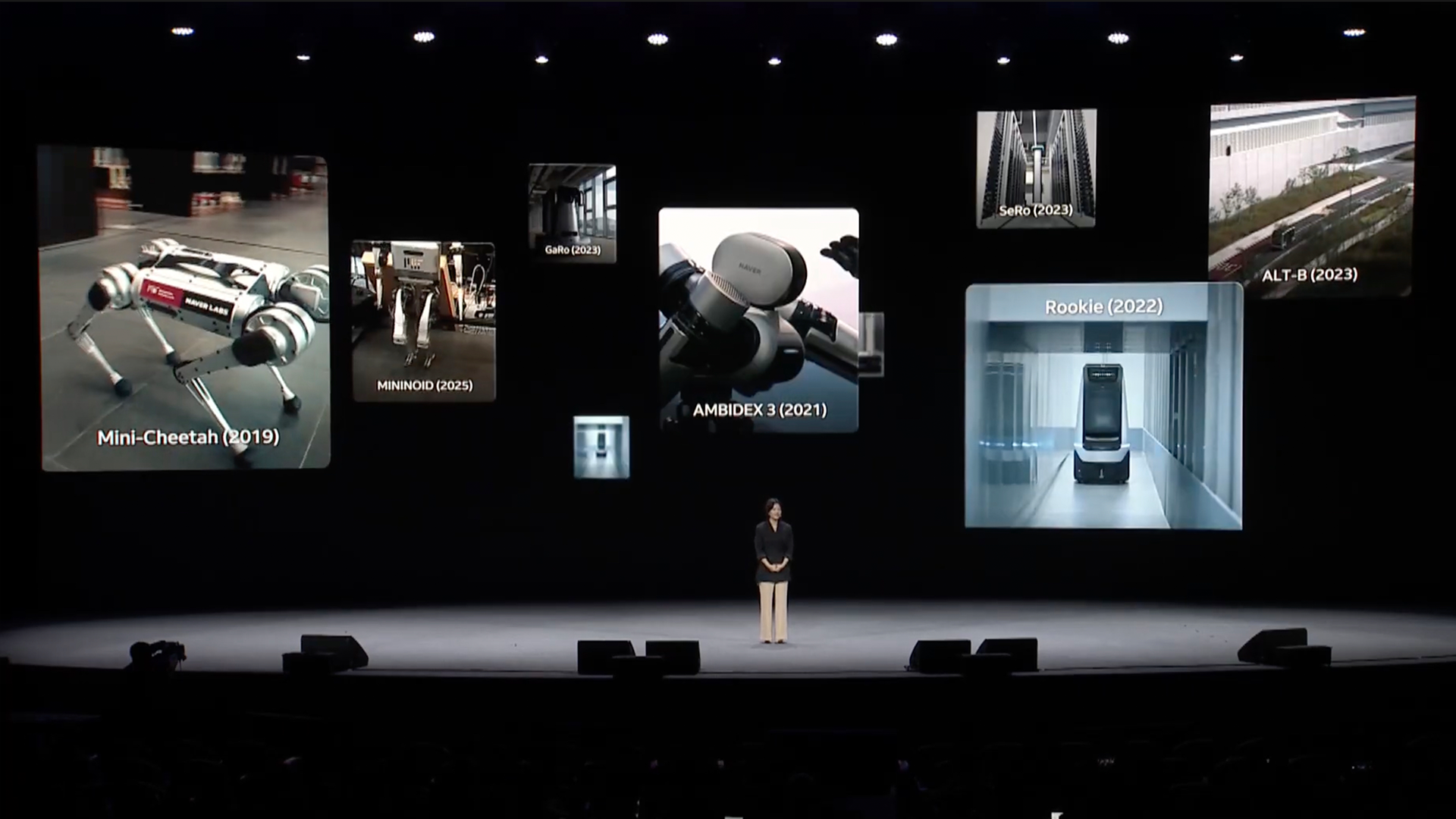
NAVER also possesses a diverse range of robotic hardware to test Physical AI. Its lineup includes wheel-based robots such as Rookie 2, GaRo, and SeRo; the quadruped robot Mini Cheetah; the dual-arm robot AMBIDEX; and the autonomous shuttle ALT-B. In addition, NAVER has initiated new collaborative research projects with MIT and KAIST, including the bipedal robot MININOID and outdoor autonomous robots.
From testbeds, models, and data to services, cloud infrastructure, and robotic hardware, NAVER LABS possesses the complete ecosystem. With this foundation, NAVER’s AI is expanding beyond the screen and into the physical world.