For some robots, pedestrians might simply appear as moving obstacles. For others, they may be seen as service recipients. But from any perspective, people are an essential subject of exploration for robots, because only by understanding humans correctly can robots coexist with them safely and naturally.
To this end, NAVER LABS Europe is conducting research through the HUMANS project, which focuses on developing robotic perception technologies that enable a deeper understanding of people. The project’s core goal is to help robots recognize and respond to humans in ways that are safe, intuitive, and socially appropriate.
For robots to interact naturally with people, they must be able to grasp not only human posture, movement, and direction, but also the surrounding social context. The HUMANS project pursues this through three main areas of research—the key technological pillars behind human-aware robotics.
Human Pose Reconstruction and Motion Tracking
This technology estimates 3D meshes of multiple people, including their full bodies, hands, and faces, from a single image or video in a single shot. Unlike previous methods that first detect individuals and then go through several steps, this approach processes the entire image at once, allowing multiple people to be reconstructed simultaneously. Through this, robots can more precisely understand the postures, movements, and gaze directions of surrounding people, enabling them to predict human actions and intentions more naturally.
3D Scene Reconstruction with Humans
This technology reconstructs entire scenes, including people, in 3D, even within complex environments. Rather than simply separating the background and humans, it generates detailed 3D point maps that contain information about human positions and shapes, allowing robots to perceive real-world spaces with much higher accuracy.
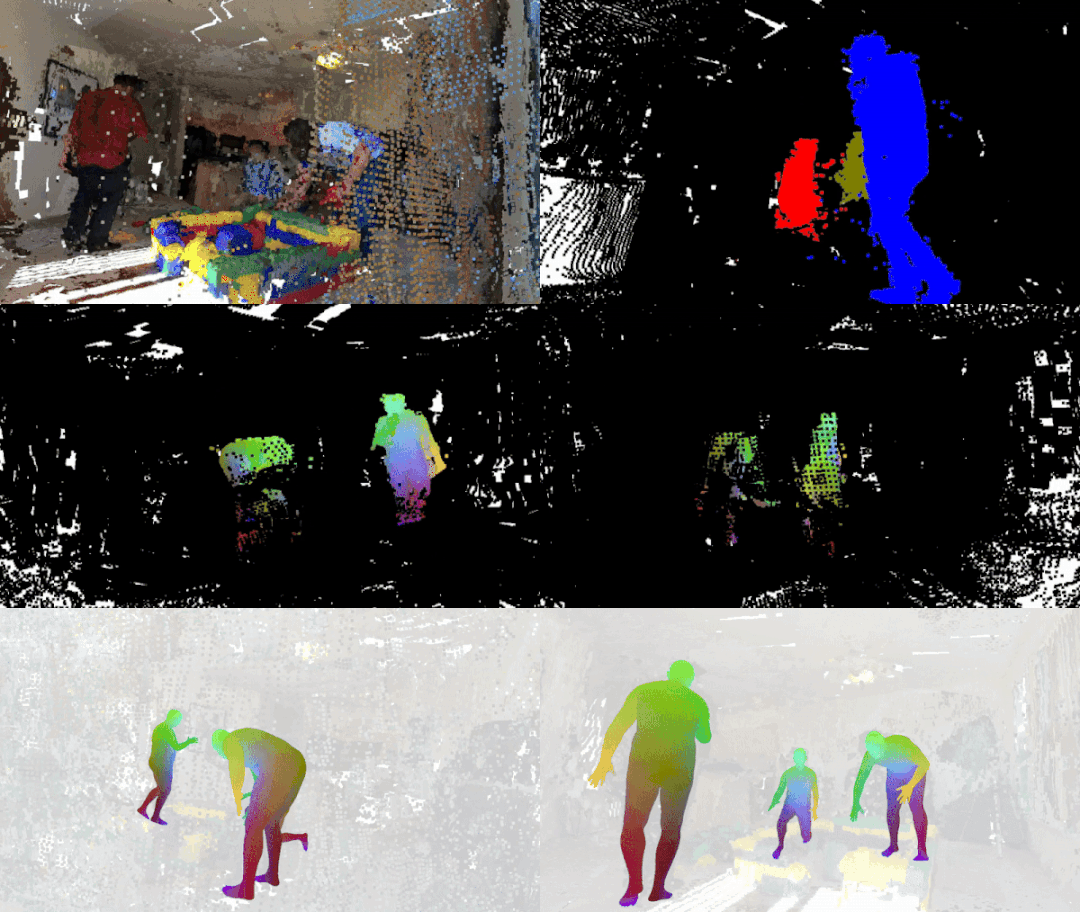
3D Human Body Models Reflecting Diverse Physical Characteristics
We are developing 3D human body models that can easily adjust parameters such as age and body type to reflect a wide range of physical traits. Instead of using real-world scan data, these models are built on anthropometric measurements, allowing them to represent a wide range of body shapes, from children to the elderly. This helps robotic perception systems recognize and understand diverse individuals more fairly and accurately.
These studies play a key role in advancing robots from the stage of simply detecting humans to the stage of truly understanding them.
High-quality data is also essential. Since small body parts such as hands and facial expressions are often hard to capture in images, we create and use specialized datasets that include close-up views of these regions. Datasets containing diverse poses and gestures help robots interpret and predict human behavior in much finer detail.
Through the HUMANS project, we aim to evolve robot perception beyond fragmented recognition toward a richer, multidimensional understanding of human behavior. In doing so, we are laying the scientific foundation that allows robots to perceive human actions on their own and respond in ways that are safe, natural, and human-centered.