SusHi Tech, held in Tokyo, was more than a technology exhibition; it served as a platform to discuss how future cities and societies should be designed. During the event, NAVER hosted a session under the theme “From AI to Society,” highlighting how AI can evolve beyond individual use cases to become a large-scale social infrastructure that spans entire cities.
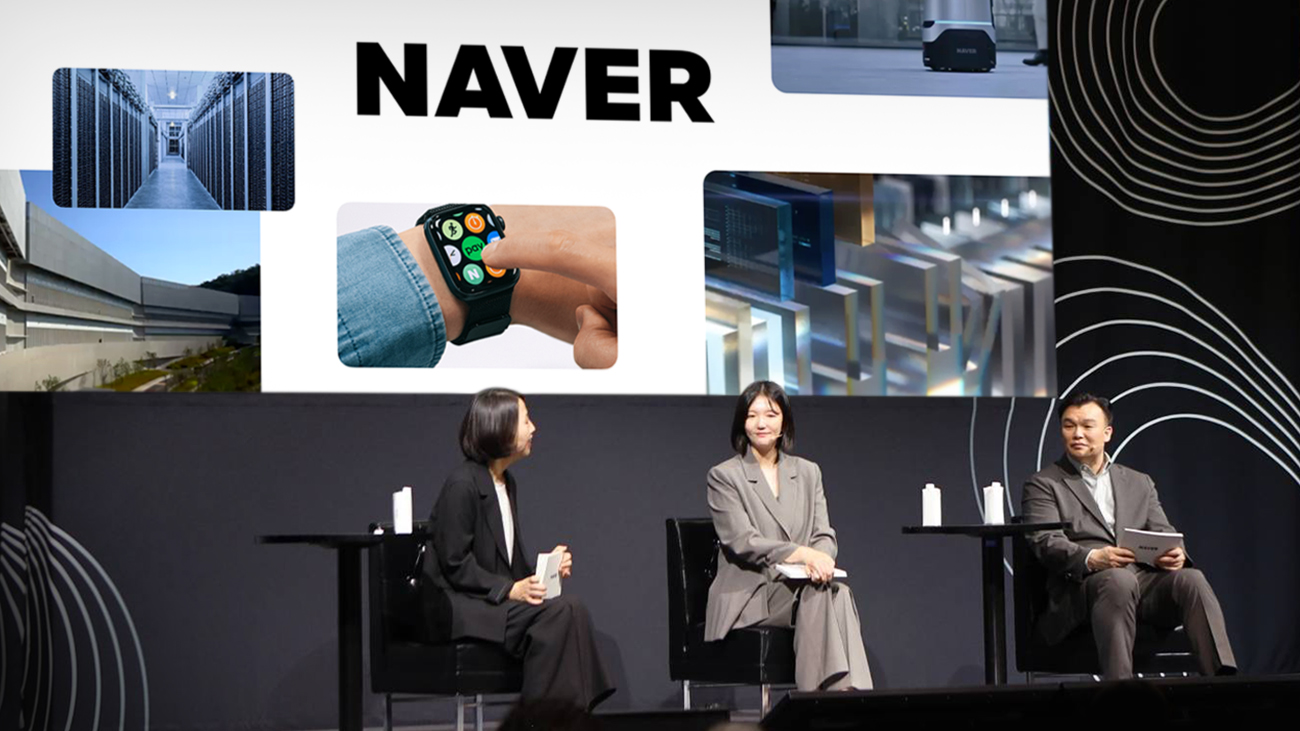
From AI to Society
CEO Choi Soo-yeon outlined NAVER’s vision for AI as follows:
“NAVER’s AI is not just about building larger and more advanced models. Our goal is to deliver innovative AI services to users, create new growth opportunities for small businesses and creators, and empower each country to maintain its digital sovereignty.”
This statement highlights a shift in perspective. AI is not viewed as a standalone function or service, but as a form of social infrastructure that supports everyday life.
Solutions such as CareCall, which helps address workforce shortages in aging societies, and AI OCR technology that transforms handwritten receipts and contracts into structured data illustrate this vision in practice. By lowering technological barriers and expanding accessibility, these innovations show how AI can become an inclusive social infrastructure that benefits everyone.
Scaling the “1784” Experiment to the Global Stage
Another key message of the presentation was showing how NAVER is expanding technologies validated in-house into cities and global environments.
Through 1784, the company’s second headquarters, NAVER has integrated robotics, spatial intelligence, and digital twin technology. Within this microcosm of a city, around 5,000 employees and over 100 robots coexist, continuously generating and refining real-world data daily.
“We have been working to extend NAVER’s strong software capabilities into the physical world. Our focus is on ensuring that advanced and distinctive technologies such as spatial intelligence, physical intelligence, digital twins, and robotics move beyond the lab and are seamlessly embedded into urban infrastructure to deliver tangible value.” (Seok Sang-ok, CEO of NAVER LABS)
This progress is now reaching global partners. In Japan, NAVER collaborated with NTT East to conduct a robot service pilot at Tokyo Midtown Yaesu. In Saudi Arabia, active discussions are underway to collaborate on NAVER’s robotics technologies in connection with large-scale, national smart city projects, such as NHC and New Murabba.
Technology for Connecting Future Cities
“AI is no longer confined to screens; it has begun to move within real spaces. That raises a key question: Are our spaces ready to welcome AI?” (Choi Soo-yeon, CEO of NAVER)
As CEO Choi Soo-yeon suggests, the technological vision for future cities is not limited to robots alone. It extends to the digitalization of space, mobility interfaces that connect urban logistics networks with building interiors, and last-mile flows that bridge outdoor and indoor environments. Therefore, what matters is not just the performance of individual technologies, but how seamlessly these new infrastructures are connected within the city.
This vision is well reflected in the robot Nuri, introduced during the presentation. More than a delivery robot, Nuri is designed to navigate complex urban environments using NAVER Map data, move seamlessly between indoor and outdoor spaces, interact with building infrastructure, and connect digital services such as shopping and payments with physical environments. Only through such integration can robots truly function as a medium that connects urban spaces, services, and user experiences.
The presentation also addressed NAVER’s perspective on sustainable AI.
“We believe true sustainability emerges from a careful balance between technological scalability and social responsibility. NAVER is constantly striving to find that optimal balance.” (Choi Soo-yeon, CEO of NAVER)
Through this presentation, NAVER emphasized that AI and robotics are no longer just tools for improving efficiency in specific industries but can serve as a foundation for enhancing the quality of life in cities. The competitiveness of future cities will depend not on how advanced the technology is, but on how naturally people, spaces, and services are connected. NAVER is now beginning to describe that connection not as a service, but as infrastructure.