On July 9, 2025, NAVER LABS CEO Seok Sang-ok delivered a plenary session at the IEEE World Haptics Conference 2025, introducing NAVER LABS’ vision for spatial intelligence, digital twins, cloud, and robotics for future cities. His presentation outlined the company’s direction and core technologies for robotic services operating at the scale of entire cities.
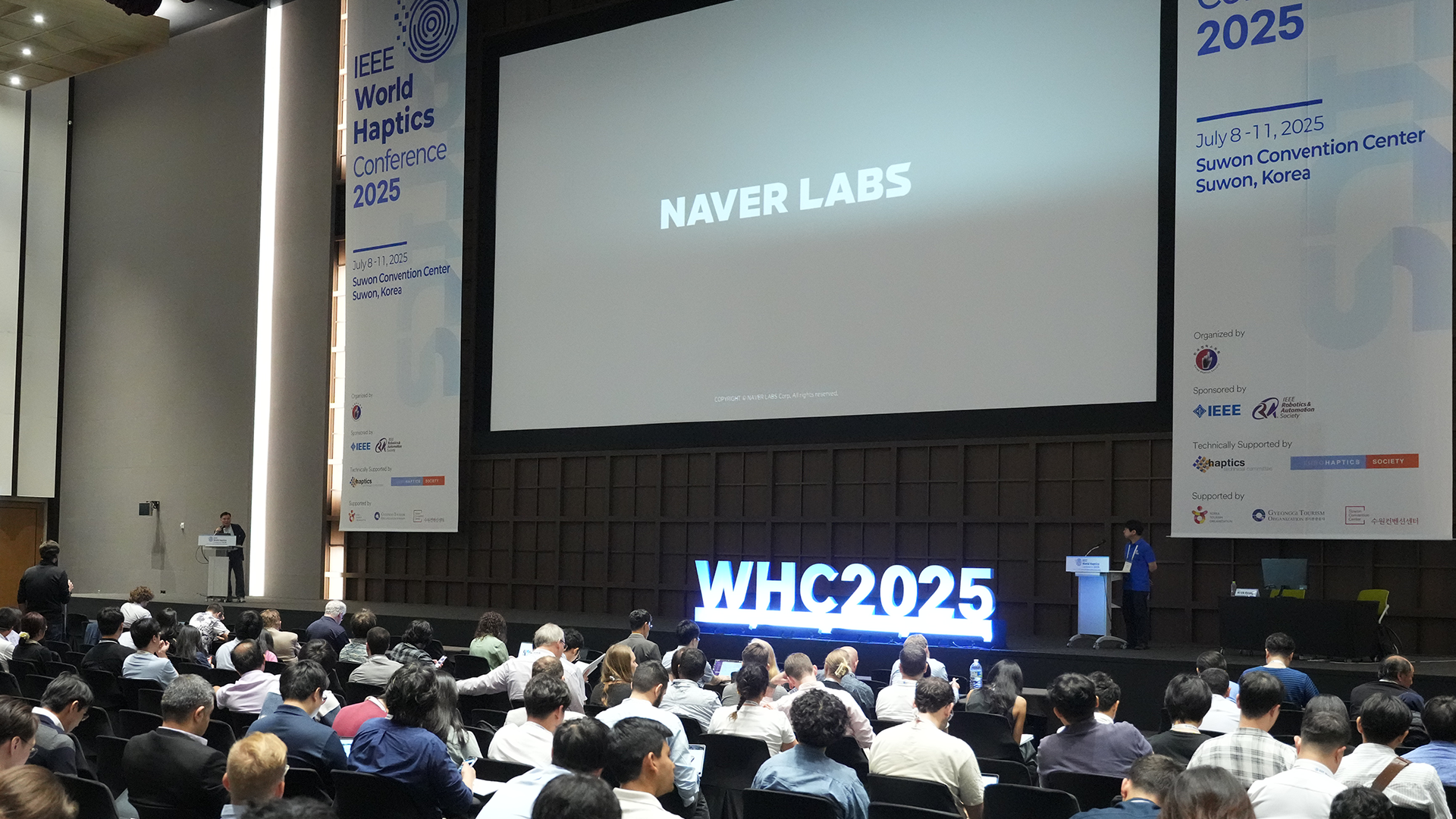
NAVER LABS CEO Seok Sang-ok presenting at the Plenary Session of the IEEE World Haptics Conference 2025
From Buildings to Cities: Scaling Robotics
Seok began by envisioning a future where “tens or even hundreds of thousands of robots will move organically through cities, connecting people and spaces.” He explained how NAVER is preparing for that future: building the eyes and brains of all robots in the cloud, expanding their capabilities through AI, and enabling anyone to create robotic services via a web-based operating system.
Following the large-scale validation of NAVER 1784, which operates and coordinates more than 100 robots, NAVER LABS is now expanding spatial intelligence through its Sejong Data Centers—moving from building-level operations to campus-scale, and ultimately to city-scale deployment. The presentation highlighted the key technologies making this possible.
Digital Twin and Spatial Intelligence
Autonomous mobility in urban environments requires advanced spatial perception. NAVER uses Digital Twin technology to replicate and manage both indoor and outdoor spaces in 3D, integrating Visual Localization to enable seamless navigation between indoor and outdoor environments.
Seok emphasized, “The digital twin is the most essential technology for urban robots and machines, and visual localization is the key to expanding their capabilities.”
Cloud-Based Robotic Software
Cloud robotics forms the foundation for large-scale robot operations. As the number of robots increases, individual control becomes inefficient, making cloud coordination essential. Since unveiling the world’s first “Brainless Robot” at CES 2019, NAVER has developed its proprietary cloud-based multi robot intelligence system, ARC and validated it in the NAVER 1784 smart building. ARC is designed to connect and manage not only identical robots but also heterogeneous robot fleets within a single system, proving both scalability and efficiency in real-world environments.
Foundation Models and Robot AI
To interact naturally with humans and respond flexibly to complex situations, robots require advanced cognitive and decision-making capabilities. Since 2021, NAVER LABS Europe has shifted its AI research focus toward Foundation Models that unify vision, action, and interaction intelligence. The ongoing research aims to integrate these capabilities into a single, generalized model, enabling robots to better understand and adapt to the diverse and dynamic conditions of future urban environments.
Web-Based Robot OS
Another key technology introduced was ARC mind, a web-based robot operating system designed to expand the robot service ecosystem. As the world’s first web platform-based robot OS, ARC mind allows web developers to easily build scalable robot services without needing motor or sensor programming. Through dedicated web APIs, developers can implement functions such as ordering, delivery, or payment, making robot development accessible to a broader community.
Seok noted, “This is an essential foundation for the expansion of robot services, as well as a turning point that will transform all robots into web-based devices.”
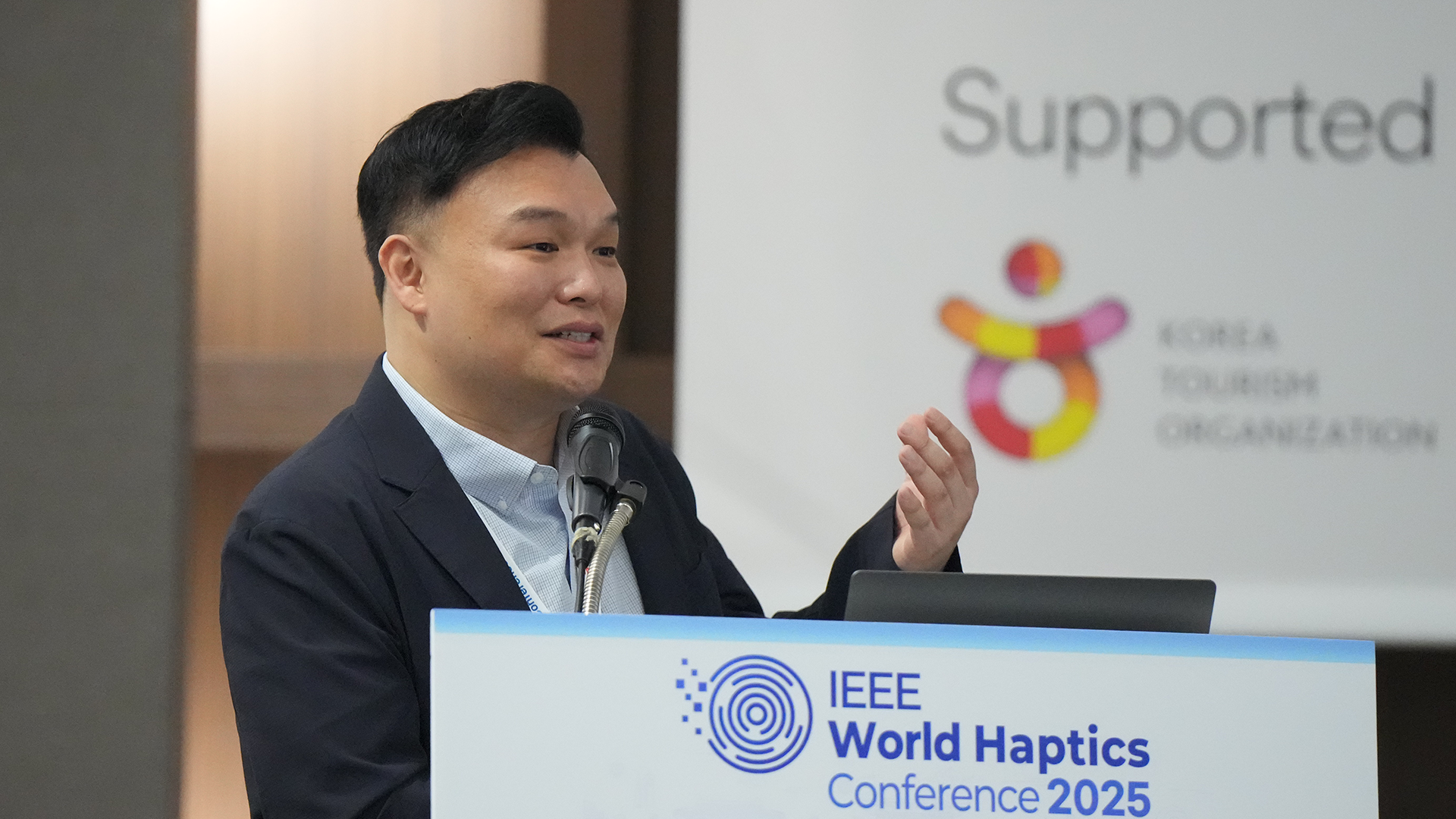
NAVER LABS CEO Seok Sang-ok presenting at the Plenary Session of the IEEE World Haptics Conference 2025
Expanding from Korea to Global Smart Cities
NAVER’s technologies are already expanding globally, shown in a current collaboration with Japan’s leading telecom operator NTT Group on a smart building project in Tokyo. In Saudi Arabia, NAVER LABS has built digital twin platforms across key cities and is now deepening its partnership with New Murabba, a major smart city development in Riyadh.
Seok concluded, “A true smart city can only be achieved when robotics, digital twins, AI, and cloud systems are organically connected within one ecosystem. NAVER LABS will continue to collaborate with global partners to make that vision a reality.”